Why Metal Roof Colour Matters More Than You’d Expect
The best colour for a metal roof isn’t just about curb appeal. It affects fade longevity, surface temperature, thermal cycling stress on fasteners, and long-term maintenance costs. Since 2012, our crews at RonOvations have installed Decra stone-coated steel, standing seam, and corrugated metal profiles across Ontario. We’ve watched the same colour in two different finishes age in completely different ways on the same street. That field experience is what most online colour guides are missing.
Manufacturer swatch cards look great in a showroom. They don’t tell you what happens after 100+ freeze-thaw cycles a year, UV exposure through thin winter cloud cover, and acid rain in the Golden Horseshoe. This guide uses real SRI data and our own 5-12 year fade observations to help you pick a colour that still looks right when your neighbours are already dealing with premature roof repairs.
SRI Numbers Explained: What Actually Drives Energy Performance
Does metal roof colour affect home energy costs?
Yes, but probably less than you’ve been told. The Solar Reflectance Index (SRI) combines solar reflectance and thermal emittance on a 0-100 scale. Energy Star rated steep-slope metal roofing requires an initial reflectance of at least 0.25. A white or light grey metal roof typically scores SRI 70-82, while charcoal sits around 5-25.
In Ontario, where you’re running the furnace seven months a year, the cooling savings from a high-SRI roof are real but modest. We’re talking $100-$300 annually on a typical 1,800 sq ft home. The bigger benefit? High-SRI panels experience less thermal cycling. That means fewer expansion-contraction cycles stressing clips, fasteners, and sealant joints over 30 years. It’s a durability argument, not just an energy argument. If you’re wondering does a new roof help with insulation, the answer is yes, but the gains come primarily from upgrading the attic insulation assembly during the reroof, not from the panel colour alone.
What is SRI and why should you care about it?
SRI is a single number that tells you how well a roof surface rejects solar heat relative to a standard white (SRI 100) and standard black (SRI 0). You’ll find SRI values on manufacturer spec sheets for products like Decra stone-coated steel panels. Ontario’s Supplementary Standard SB-10 references energy efficiency provisions that touch on roof reflectance, so SRI isn’t just marketing fluff. If you’re building new or doing a major renovation, your designer may need to account for it under the Ontario Building Code (OBC).
Dark vs. Light Metal Roofs in Ontario’s Four-Season Climate
Are dark metal roofs too hot for Ontario summers?
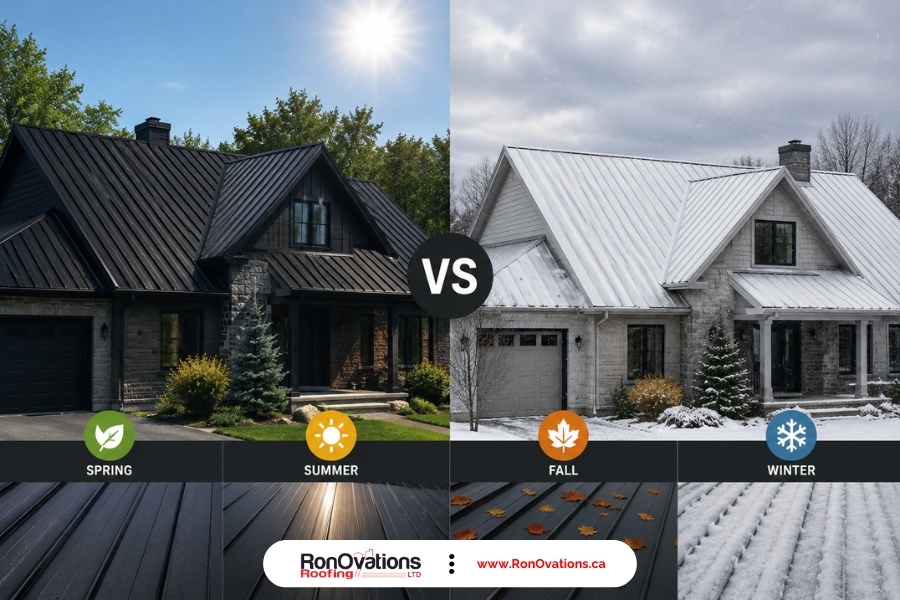
A dark metal roof can run 15-25°C hotter at the surface than a light one on a July afternoon. That sounds alarming, but it doesn’t mean your living room turns into a sauna. With proper attic ventilation and insulation upgrades, which the OBC requires, the interior temperature difference is minimal. We’ve measured attic temps on dark charcoal standing seam installs in Barrie and found only a 2-3°C difference compared to light grey panels on a neighbouring home with identical insulation.
Modern PVDF coatings now include infrared-reflective (IR) pigments that let a dark colour reject more heat than its appearance suggests. A charcoal panel with IR pigments can perform like a medium-toned roof thermally while still looking dark. If you want a dark metal roof, don’t let the heat myth scare you off. Just make sure your attic assembly is built to code.
Can you get ice dams with a metal roof, and does colour matter?
Metal’s smooth surface sheds snow faster than asphalt shingles like GAF Timberline HDZ or Owens Corning Duration, which helps reduce ice dam risk. But colour plays a subtle role. Dark panels absorb more solar heat, which can accelerate snowmelt at the eaves if ventilation is poor. That meltwater refreezes at the cold overhang and you’ve got an ice dam. So do metal roofs prevent ice dams entirely? Not automatically. In Ontario, with over 100 freeze-thaw cycles annually in many regions, proper soffit-to-ridge ventilation and adequate insulation matter far more than colour. We’ve seen well-ventilated dark roofs perform flawlessly and poorly ventilated light roofs dam up every March.
How Much Is a Metal Roof Compared to Asphalt?
Before choosing a colour, most homeowners want to know how much is a metal roof relative to traditional shingles. In Ontario, installed costs for standing seam metal roofing typically run $12-$18 per square foot (CAD), while corrugated or snap-lock panels come in at $8-$14/sq ft. By comparison, a mid-range asphalt shingle like IKO Dynasty or CertainTeed Landmark runs $5.50-$8.50/sq ft installed. The premium for metal is real, but when you factor in a 40-50 year lifespan versus 20-25 years for asphalt, the lifecycle cost often favours metal roofing. We’ve broken down the full comparison in our roof replacement cost guide.
PVDF vs. SMP Paint Finishes: The Factor Most Guides Skip
What paint finish (PVDF vs SMP) keeps metal roof colour longest?
This is the single most important variable in metal roof colour longevity, and it’s the one most homeowners don’t know about. PVDF (polyvinylidene fluoride), branded as Kynar 500 or Hylar 5000, is a resin-based coating that resists UV degradation, chalking, and colour shift far longer than SMP (silicone-modified polyester).
On our Ontario installs, PVDF panels still look close to original after 12 years. SMP panels in the same neighbourhood, same orientation, same colour, show visible chalk and fade by year 6-7. The difference is dramatic on saturated colours like barn red or navy blue. PVDF costs roughly 15-25% more per panel, which works out to about $0.75-$1.50 extra per square foot installed. That’s a fraction of the $3-$6/sq ft you’d spend repainting faded SMP panels down the road.
Here’s our honest take after installing both finishes for over a decade: if you’re choosing a bold or saturated colour, PVDF isn’t optional. It’s the only finish that’ll hold that colour long enough to justify the investment. SMP is fine for muted earth tones and lighter shades where fade is less noticeable.
What metal roof colours fade the least in Canadian weather?
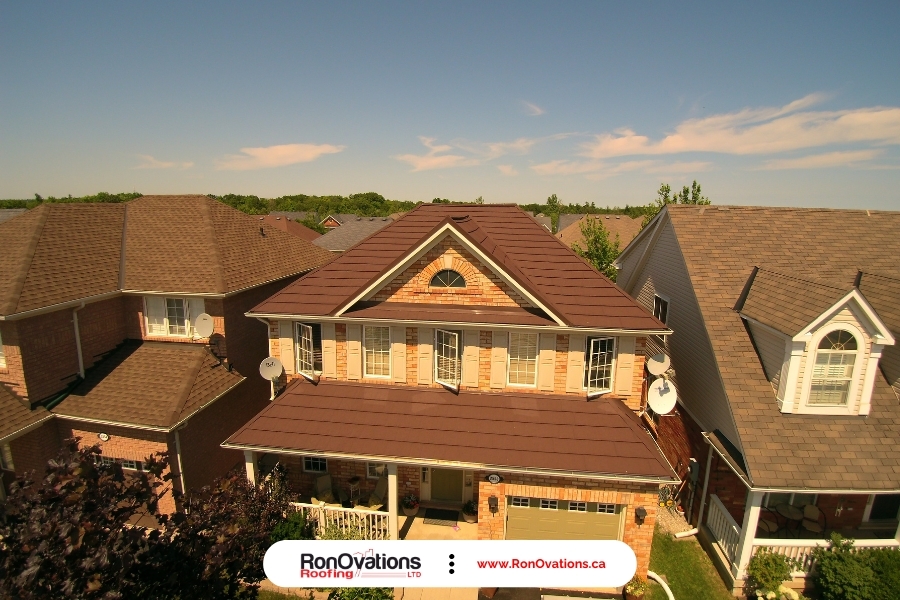
In PVDF, charcoal grey and bronze earth tones fade the least. They use inorganic pigments that resist UV breakdown. Reds and dark blues in SMP fade fastest because their organic pigments are more vulnerable. We’ve pulled SMP red panels off a Kawartha Lakes cottage after just eight years and the colour had shifted from barn red to a washed-out salmon. Manufacturer warranties often exclude “normal” colour change, so the finish you choose up front is your real protection.
Does a Metal Roof Attract Lightning?
Do metal roofs attract lightning strikes?
This is one of the most persistent myths in metal roofing. No, metal roofs do not attract lightning. Lightning strikes the highest point in an area regardless of material. A metal roof is no more likely to be struck than an asphalt-shingled roof at the same height and location. In fact, because metal is non-combustible, a metal roof is actually safer if lightning does strike. The energy dissipates across the conductive surface rather than igniting the roofing material. The National Building Code of Canada (NBC) does not require additional lightning protection for metal-roofed residential buildings beyond standard grounding. We’ve installed hundreds of metal roofs across Barrie, Newmarket, and Aurora and have never had a lightning-related claim.
Colour Comparison Table: SRI, Fade Resistance, and Best Finish
| Colour | Typical SRI Range | Fade Resistance (PVDF) | Fade Resistance (SMP) | Best Use Case |
|---|---|---|---|---|
| White / Bright Silver | 78-85 | Excellent | Good | Maximum reflectance, commercial, flat roofs |
| Light Grey / Pewter | 70-82 | Excellent | Good | Residential energy performance, modern aesthetic |
| Medium Bronze | 30-45 | Excellent | Fair | Earth-tone homes, rural properties |
| Charcoal / Dark Grey | 5-25 | Excellent | Fair | Contemporary homes, urban streetscapes |
| Barn Red | 15-30 | Good | Poor | Agricultural, heritage, cottage (PVDF only) |
| Dark Blue / Navy | 10-25 | Good | Poor | Coastal, cottage (PVDF strongly recommended) |
| Forest Green | 20-35 | Good | Fair | Rural, wooded lots, heritage homes |
| Black | 0-5 | Good | Fair | Modern/architectural (ensure IR pigments) |
Choosing Metal Roof Colour by Home Style
Colour choice isn’t just technical. It needs to work with your home’s architecture and your municipality’s guidelines. Here’s what we’ve seen work well across our Toronto and Vaughan projects:
- Modern/contemporary: Charcoal, matte black, or dark zinc grey in standing seam. Clean lines suit flat-lock or snap-lock profiles.
- Traditional/colonial: Medium bronze, slate grey, or forest green. Decra stone-coated steel mimics the texture of conventional shingles while delivering metal longevity.
- Farmhouse/rural: Barn red (PVDF only), weathered copper, or galvalume silver. Corrugated profiles suit this aesthetic.
- Cottage/lakefront: Muted greens, blues, or natural weathering finishes. These blend with the landscape and meet many Muskoka-area design guidelines.
Frequently Asked Questions
Does a metal roof attract lightning during storms?
No. Does a metal roof attract lightning? This is a common misconception. Metal roofing does not increase the probability of a lightning strike. Lightning seeks the path of least resistance to ground, targeting the tallest object in an area regardless of its material. Metal is non-combustible, making it a safer roofing choice if a strike does occur. The Canadian Electrical Code and NBC grounding requirements apply the same way they do for any roofing material.
Will a metal roof help with my home’s insulation?
A metal roof alone doesn’t insulate your home. However, during a roof replacement, it’s the ideal time to upgrade attic insulation to current OBC standards (R-60 for attic spaces in Climate Zone 6). The combination of a properly insulated attic and a metal roof’s reflective properties can reduce heating and cooling costs by 15-25% compared to an aging asphalt roof with depleted insulation. We always recommend pairing a metal roofing install with an attic insulation assessment.
How long does a metal roof colour warranty last?
PVDF finish warranties typically cover colour fade and chalk for 30-40 years, though the fine print often allows for “acceptable” colour change of 5-7 Delta E units. SMP warranties are shorter, usually 20-25 years, with wider tolerances for fade. Always read the warranty exclusions. Coastal salt exposure, industrial fallout, and improper cleaning can void coverage. On our installs, we walk clients through the specific warranty terms for their chosen panel and finish before ordering.
Picking a Metal Roof Colour That Lasts
The best metal roof colour is the one that still looks right after 15-20 years of Ontario weather. That means choosing PVDF over SMP for any saturated colour, understanding that SRI matters more for durability than energy savings in our climate, and matching your colour to your home’s style and neighbourhood context. Charcoal grey and bronze earth tones in PVDF remain the safest long-term choices for most Ontario homes, while lighter shades offer modest cooling benefits and excellent fade resistance in either finish. The colour comparison table above gives you the SRI and fade data to make a confident decision.