The Real Problem with Commercial Roof Insulation in Canada
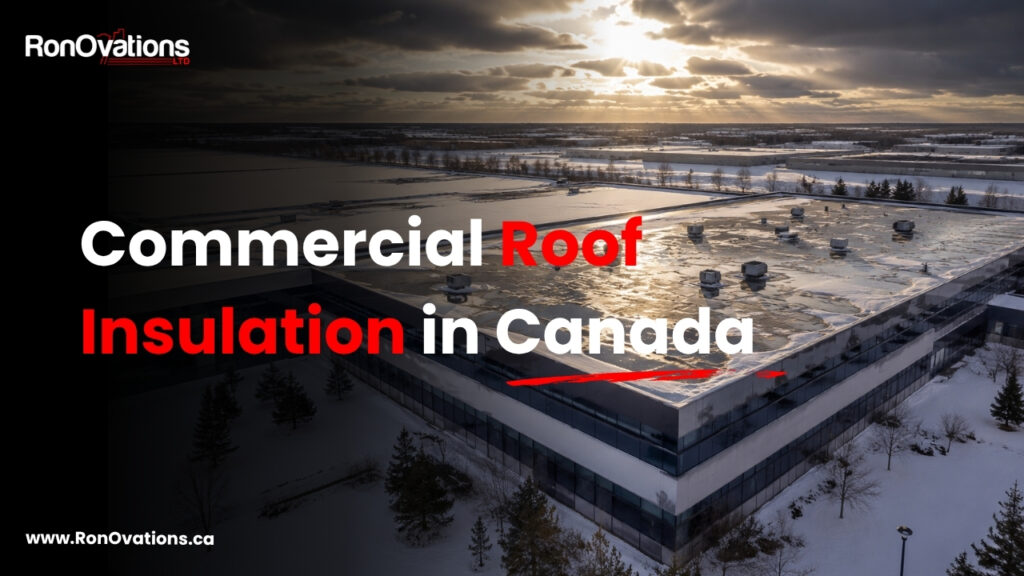
Commercial roof insulation in Canada costs $1.00 to $6.00 per square foot installed, must meet NBC minimums of R-31 to R-41 by climate zone, and fails in cold weather more often than most building owners realize. The failures aren’t random. They follow a pattern we’ve documented across Ontario, Manitoba, and Alberta since 2012: spec sheets promise one R-value, but sustained cold delivers another. At RonOvations LTD, we’re GAF Certified, Owens Corning Preferred Contractors, and IKO ShieldPro Plus installers. We’ve torn off hundreds of commercial roof assemblies and measured what’s actually happening beneath the membrane with thermal imaging. The gap between lab-rated performance and real-world cold-climate performance is the single biggest source of code compliance problems on Canadian commercial roofs.
The main insulation types you’ll encounter are polyiso, EPS (expanded polystyrene), XPS (extruded polystyrene), spray polyurethane foam (SPF), and mineral wool. Each has a place, but none is universally right for every Canadian climate zone. If you’re wondering how much does metal roofing cost for a commercial building, the insulation layer underneath is often the bigger variable in total project pricing. This article breaks down code requirements province by province, explains which materials actually hold their R-value in our winters, covers 2026 costs, and outlines retrofit options and available rebates. asphalt shingle installation.
R-Value, Thermal Bridging, and Why They Matter on Commercial Roofs
What does R-value actually measure on a commercial roof?
R-value measures thermal resistance per inch of material. Higher R-value means slower heat transfer through the roof assembly. But here’s what most spec sheets won’t tell you: R-value is tested at a mean temperature of 24°C (75°F). That’s nowhere near a Winnipeg January. The number on the data sheet is a starting point, not a guarantee. roofing maintenance.
How does thermal bridging reduce your effective insulation?
Thermal bridging happens when steel deck fasteners, metal curbs, HVAC penetrations, and parapet connections create direct paths for heat to bypass insulation. On a typical mechanically fastened commercial roof, thermal bridging can reduce effective R-value by 10-20%. We’ve seen buildings in Hamilton and Edmonton where the owner paid for R-36 insulation but thermal imaging showed effective performance closer to R-28 because of fastener density and uninsulated curbs. attic blown-in insulation.
Proper vapour barrier placement is non-negotiable in Canada’s heating-dominant climate. Install it on the warm side of the insulation. Get it wrong and moisture condenses inside the assembly, saturates the insulation, and corrodes the steel deck. Tapered insulation, cut at a slope to direct water toward drains, serves double duty as both insulation and drainage. The NBC sets baseline R-value minimums, but Ontario’s OBC, Alberta’s ABC, and Manitoba’s MBC each adopt or amend those requirements differently. professional roof repair work.
Ontario: What the OBC Requires for Commercial Roof Insulation
What R-value is required for commercial roofs in Ontario?
The Ontario Building Code (OBC) SB-10 requires a minimum R-31 for most commercial roof assemblies in Climate Zone 6 (southern Ontario, including Toronto, Hamilton, and Ottawa) and R-36 or higher in Zone 7 (northern Ontario, including Sudbury and Thunder Bay). Ontario adopted the 2017 NBC energy tier with amendments, so you’ll want to confirm the current SB-10 or SB-12 supplements before specifying insulation. flat roof system options.
We’ve observed that many older Ontario commercial buildings carry only R-16 to R-20 of original insulation. That’s well below current code if a full tear-off triggers the upgrade requirement. On a recent strip mall re-roof in Mississauga, the existing polyiso was rated R-20 but thermal imaging showed effective performance around R-14 due to moisture absorption and thermal bridging through the fasteners. our Vaughan Roofing Company roofing service.
Polyiso performs reasonably well in Ontario’s Zone 6 climate, where sustained temperatures below -15°C are less common than in Manitoba or Alberta. Still, we recommend adding a layer of EPS or XPS underneath as a thermal break on steel decks. We install Mule-Hide TPO and Carlisle EPDM membrane systems over these assemblies regularly, and the hybrid approach consistently passes inspection without callbacks. roofing work in Toronto.
Manitoba: Vapour Barrier Failures We’ve Seen First-Hand
Why does vapour barrier placement matter more in Manitoba?
Manitoba’s building code aligns closely with the NBC but enforces stricter vapour barrier requirements because of extreme cold. Winnipeg sits in Climate Zone 7A/7B and regularly hits -35°C. The R-value requirement is R-36 minimum for commercial roofs in most Manitoba municipalities, and some energy-conscious specs push to R-40. our Aurora Newmarket Roofers roofing service.
On older Manitoba commercial buildings built before 1990, we routinely find the vapour barrier installed on the wrong side of the insulation or punctured by mechanical fasteners. The result is condensation pooling on the steel deck, corrosion eating through the metal, and insulation that’s waterlogged and functionally useless. We documented one warehouse in Winnipeg where the vapour barrier had been placed above the insulation instead of below it. The deck had corroded through in three spots within eight years of the original install. maintenance tips how to care.
Mineral wool is gaining popularity in Manitoba for its fire resistance and stable R-value in cold. It doesn’t derate the way polyiso does. But it’s heavier and more expensive per R than polyiso, so structural load calculations matter. In Manitoba’s climate, polyiso boards can lose 25-30% of their rated R-value at sustained temperatures below -15°C. That’s a fact lab-rated R-values on spec sheets don’t advertise, and it’s the single biggest reason we see code compliance failures in the province.
Alberta: Where Polyiso Alone Won’t Cut It
Is polyiso insulation reliable in extreme Canadian cold?
No, not as a standalone material. Polyiso’s R-value per inch drops from the advertised R-6.0 to roughly R-4.0 to R-4.5 at -20°C. We’ve confirmed this with thermal imaging on Alberta re-roofs in Edmonton and Red Deer. If you spec a 3-inch polyiso board expecting R-18, you’re actually getting closer to R-12 to R-13.5 during the coldest months. That gap can push an entire assembly below code.
What insulation do Alberta commercial buildings actually need?
The Alberta Building Code requires R-31 to R-41 depending on climate zone. Edmonton falls in Zone 7A, Calgary in Zone 6. We recommend hybrid assemblies: a base layer of EPS or XPS (both hold stable R-value in cold) topped with polyiso (higher R per inch in moderate temperatures). This combination gives you code-compliant effective R-value year-round without over-building thickness.
We use IKO insulation boards and Carlisle SynTec systems on Alberta commercial projects. Alberta straddles Zones 6 and 7A, so the same metro area can have different requirements depending on exact location and building use. Calgary’s chinook cycles add another wrinkle: rapid freeze-thaw stresses adhesives and can cause delamination if the membrane system isn’t designed for thermal cycling. It’s one reason we favour mechanically attached systems in southern Alberta over fully adhered ones.
Insulation Material Comparison for Canadian Commercial Roofs
Which commercial roof insulation holds its R-value in Canadian winters?
EPS, XPS, SPF, and mineral wool all maintain stable R-values in cold. Polyiso doesn’t. Here’s how they compare across the factors that matter most on a Canadian commercial roof:
| Material | Rated R-Value per Inch | Effective R-Value Below -15°C | Moisture Resistance | Fire Rating | Cost per Sq Ft (CAD, Installed) |
|---|---|---|---|---|---|
| Polyiso | R-6.0 | ~R-4.2 (drops 25-30%) | Moderate | Good | $1.50 – $3.00 |
| EPS | R-3.8 to R-4.2 | Stable | Low (absorbs moisture) | Fair | $1.00 – $2.00 |
| XPS | R-5.0 | Stable | High | Good | $1.75 – $3.25 |
| SPF (Closed-Cell) | R-6.0 to R-7.0 | Stable | High | Excellent (with coating) | $3.00 – $6.00 |
| Mineral Wool | R-4.0 | Stable | High | Excellent | $2.50 – $4.50 |
For most Canadian commercial roofs, a hybrid polyiso-over-EPS assembly offers the best balance of cost, code compliance, and real-world cold performance. If fire resistance is the priority, mineral wool or SPF with an intumescent coating is the better call. XPS works well in high-moisture environments like food processing facilities, but its higher cost and environmental profile (HFC blowing agents in older formulations) are worth considering.
Can You Retrofit Insulation on an Existing Flat Commercial Roof?
What are the retrofit options for existing flat commercial roofs?
Yes, you can retrofit insulation on an existing flat commercial roof, but the method depends on the condition of the existing assembly and whether you’re doing a full tear-off or a recover (overlay).
If the existing membrane and deck are structurally sound, new insulation boards can be mechanically fastened or adhered on top, then a new membrane installed over them. This recover approach avoids tear-off costs but adds roof height, so you’ll need to check parapet and flashing clearances. We’ve done recovers on warehouses in Brampton and Calgary where adding 3 inches of new insulation brought the assembly from R-16 to R-34 without touching the original deck.
A full tear-off involves stripping everything to the deck, inspecting for rot or corrosion, and installing a new vapour barrier, insulation, and membrane from scratch. It’s more expensive but necessary if the deck is compromised. We find compromised decks on roughly 30-40% of pre-1990 commercial buildings we open up.
Is blown-in insulation an option for commercial flat roofs?
Blown in insulation isn’t suitable for membrane roof assemblies. It’s designed for attic spaces on sloped commercial or industrial buildings, where it can fill cavities and irregular spaces effectively. Blown attic insulation works well in those applications, but for flat roofs, rigid board insulation or SPF are the appropriate choices. Learn more about blown attic insulation options.
Spray polyurethane foam can be applied directly over some existing roof surfaces, creating a monolithic insulated layer with no seams. Proper surface prep and a protective elastomeric coating are required. Any retrofit covering more than 50% of the roof area typically triggers a code-required insulation upgrade to current standards.
How Much Does Commercial Roof Insulation Cost in Canada in 2026?
How much does commercial roof insulation cost in Canada in 2026?
Insulation-only costs (material plus labour) per square foot for commercial roofing insulation in Canada in 2026 break down as follows:
- Polyiso: $1.50 – $3.00/sq ft
- EPS: $1.00 – $2.00/sq ft
- XPS: $1.75 – $3.25/sq ft
- SPF (closed-cell): $3.00 – $6.00/sq ft
- Mineral wool: $2.50 – $4.50/sq ft
These are insulation-only figures. Total re-roof costs including membrane, labour, tear-off, and disposal run significantly higher. A complete commercial flat roof replacement with insulation upgrade on a 10,000 sq ft building typically lands between $80,000 and $180,000 depending on material choices and existing conditions.
Costs vary by province. Alberta labour rates tend to run 10-15% higher than Ontario for commercial roofing, with Manitoba falling in between. For context on residential metal options, how much is a metal roof depends heavily on profile and gauge, but commercial metal roof maintenance costs are a separate consideration from insulation budgeting. These are 2026 estimates and fluctuate with material supply chains and fuel costs. We’ve seen polyiso prices jump 12% in a single quarter when petroleum feedstock costs spiked.
Does Replacing a Commercial Roof Actually Improve Insulation?
Does a new roof help with insulation and energy bills?
A new roof alone doesn’t automatically improve insulation. The membrane keeps water out; the insulation keeps heat in. They’re separate components. But a re-roof is the best opportunity to upgrade insulation to current code because the assembly is already open and accessible.
Should you upgrade insulation during a commercial re-roof?
Absolutely. Most provincial codes require insulation upgrades to current standards when more than 50% of the roof covering is replaced. On commercial re-roofs we do across Ontario, Manitoba, and Alberta, we almost always find existing insulation below current code. Upgrading during the re-roof adds 10-20% to the project cost but can cut heating and cooling energy loss through the roof by 30-50%.
If you have a commercial metal roof, maintaining panel seams and fasteners preserves the insulation underneath. Neglected metal roofs allow water infiltration that saturates insulation and destroys its R-value within a few seasons. Proper metal roof maintenance protects your insulation investment just as much as the membrane itself. A well-insulated new roof assembly with proper vapour barrier placement also reduces ice damming on sloped sections and condensation on flat sections, both persistent Canadian problems. metal roof maintenance guide.
Energy Rebates for Commercial Roof Insulation Upgrades in Canada
What energy rebates apply to commercial roof insulation upgrades in Canada?
Several federal and provincial programs can offset commercial roof insulation costs. Rebate programs change frequently, so always verify current eligibility before budgeting, but here’s what’s available as of 2026:
- Federal: The Canada Green Buildings Strategy and NRCan programs may offer rebates for commercial building envelope upgrades that meet specific energy performance targets.
- Ontario: Save on Energy programs through local utilities sometimes cover commercial envelope upgrades. Enbridge gas rebates are available for insulation improvements that reduce natural gas consumption.
- Manitoba: Efficiency Manitoba offers commercial building envelope rebates that can offset a meaningful portion of insulation upgrade costs.
- Alberta: Energy Efficiency Alberta programs and municipal programs in Edmonton and Calgary provide incentives for commercial energy retrofits.
An energy audit before the re-roof can identify the most cost-effective insulation upgrade path and is sometimes required for rebate eligibility. We recommend getting the audit done during the assessment phase so the results inform the insulation specification rather than being an afterthought. roof replacement services.
Installation Timeline: On-Site Work vs Total Project Lifecycle
How long does commercial roof insulation installation take?
For a typical 10,000 sq ft commercial flat roof, on-site insulation and membrane installation takes 3 to 7 working days depending on weather, number of insulation layers, and crew size. That’s the actual boots-on-roof time.
The total project lifecycle, from initial assessment and energy audit through permit application, material ordering, installation, and final inspection, typically spans 4 to 8 weeks. The gap between on-site work and total timeline is mostly permits and material lead times.
Permit timelines vary: Ontario municipalities often take 2 to 4 weeks for commercial building permits, while Alberta can be faster (1 to 2 weeks in some municipalities), with Manitoba falling in between. Insulation boards and membrane adhesives have temperature minimums. Most manufacturers require ambient temps above 5°C for adhesive application, which limits the installation season in northern Alberta and Manitoba. Our crews plan commercial insulation projects for late spring through early fall to avoid cold-weather adhesion failures that we’ve seen cause warranty claims on other contractors’ work. how long a roof replacement takes.
Frequently Asked Questions
Does a new roof help with insulation?
A new roof by itself doesn’t add insulation, but a re-roof is the best time to upgrade. Most provincial codes require bringing insulation up to current R-value standards when you replace more than 50% of the roof covering. On commercial re-roofs across Ontario, Manitoba, and Alberta, we almost always find existing insulation well below current code minimums.
Does a new roof improve heating and cooling efficiency?
Yes, when insulation is upgraded during the re-roof. A properly insulated commercial roof assembly with correct vapour barrier placement can reduce heat loss through the roof by 30-50%. This translates directly to lower heating costs in winter and reduced cooling load in summer, especially in Canadian climate zones 6 and 7.
Is polyiso insulation reliable in extreme Canadian cold?
Polyiso loses significant R-value below -15°C. Its rated R-6.0 per inch can drop to R-4.0 or R-4.5 in sustained Alberta or Manitoba cold. We recommend hybrid assemblies with an EPS or XPS base layer underneath polyiso to maintain code-compliant thermal performance year-round. This is especially important in Climate Zone 7A and 7B.
What R-value is required for commercial roofs in Ontario?
The Ontario Building Code (OBC) SB-10 requires a minimum of R-31 for commercial roof assemblies in Climate Zone 6 (southern Ontario) and R-36 or higher in Zone 7 (northern Ontario). These requirements apply to new construction and to major re-roofing projects that trigger the energy code upgrade threshold.
Can you retrofit insulation on an existing flat commercial roof?
Yes. If the existing membrane and deck are structurally sound, new insulation boards can be installed on top in a recover system. If the deck is compromised, a full tear-off is needed. Spray polyurethane foam can also be applied over some existing surfaces. Any retrofit covering more than 50% of the roof area typically triggers a code-required insulation upgrade to current standards.
What’s the best insulation for commercial roofs in Alberta?
A hybrid assembly works best. Use EPS or XPS as the base layer for stable cold-weather R-value, then polyiso on top for higher R per inch in moderate temperatures. This combination delivers code-compliant effective R-value year-round in both Calgary (Zone 6) and Edmonton (Zone 7A). Single-material polyiso assemblies consistently underperform in Alberta’s sustained cold.
Choosing the right commercial roof insulation in Canada comes down to understanding your climate zone, your provincial code requirements, and how materials actually perform in cold, not just how they test in a lab. Hybrid assemblies, proper vapour barrier placement, and timing your upgrade to coincide with a re-roof are the most cost-effective path to a compliant, energy-efficient building envelope. For more on commercial and residential roofing work in Ontario, visit the Ontario roofing services page.