Quick answer: A new roof can improve insulation performance by sealing air leaks, replacing degraded underlayment, and restoring ventilation, but asphalt shingles alone add only about R-0.44. The real energy gains come when you pair a reroof with blown-in attic insulation and proper soffit-to-ridge airflow.
How a New Roof Actually Affects Your Home’s Insulation
Does a new roof help with insulation? Yes, but not the way most people assume. Shingles contribute almost zero R-value on their own. The real improvements come from fixing gaps in the roof deck, replacing cracked underlayment, and sealing penetrations around vents, plumbing stacks, and electrical masts. On older Ontario homes built before 1990, we routinely find the original felt paper has cracked and separated, creating direct air paths into the attic. That’s heat leaving your house around the clock every January.
Think of it this way: your roof is a weather shield, not a blanket. A new roof improves insulation indirectly by restoring the integrity of the assembly that protects your actual insulation layer. When that assembly fails, even R-50 attic insulation can’t do its job properly.
Does replacing shingles alone increase your R-value?
Not meaningfully. Asphalt shingles like GAF Timberline HDZ or Owens Corning Duration contribute roughly R-0.44. That’s negligible compared to the R-50 or R-60 your attic floor insulation should be providing. The improvements you’ll notice after a reroof come from the full roof assembly: new underlayment, repaired or replaced decking, and sealed penetrations. The insulation system itself, including attic floor batts or blown-in fill, vapour barrier, and ventilation, needs separate attention.
What’s the difference between the roof covering and the insulation layer?
Your roof covering (shingles, underlayment, decking) keeps rain, snow, and wind out. Your insulation layer, typically sitting on the attic floor between joists, prevents heat from escaping upward. A new roof addresses the first job. The second requires its own scope of work. Confusing the two is one of the most common misunderstandings we see.
The Underlayment and Decking Factor
Modern synthetic underlayment creates a far tighter air barrier than the old 15-lb felt paper found on most pre-2000 Ontario roofs. Products like GAF FeltBuster lay flat, resist tearing during installation, and don’t absorb moisture the way organic felt does. That moisture resistance matters because wet underlayment transfers dampness to the decking below, which eventually rots.
Rotted or delaminated decking (OSB or plywood) creates thermal bridges and air leaks. A reroof is the only practical time you can inspect and replace bad sheets. Our crews often find four to six sheets per job that are soft underfoot, spongy enough that you can push a screwdriver through them. Each compromised sheet is essentially a hole in your thermal envelope.
How does new underlayment improve insulation performance?
New underlayment improves insulation by doing two things: sealing air leaks at the deck level and providing a secondary moisture barrier. Air leaks are the silent killer of insulation performance. Even small gaps around pipe boots and exhaust vents can channel enough warm air into the attic to melt snow on the roof above. The Ontario Building Code (OBC) SB-12 outlines minimum insulation and air-barrier requirements for new construction and major renovations, and a reroof is your best opportunity to bring an older home closer to those standards.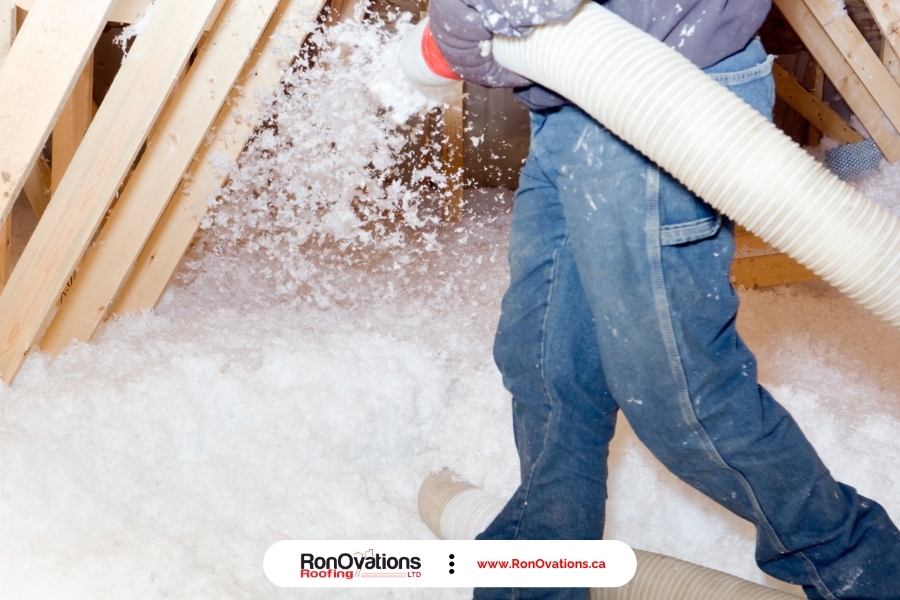
Attic Ventilation: The Insulation Multiplier Most People Overlook
You can have R-60 insulation in your attic and still lose the battle if ventilation is wrong. A balanced soffit-to-ridge airflow cycle keeps attic temperatures closer to outdoor temps in winter, preventing the moisture buildup that quietly destroys insulation from above. In summer, proper ventilation exhausts trapped heat that would otherwise radiate down through your ceiling. Understanding how a new roof helps with heating and cooling starts with getting ventilation right.
Why does attic ventilation matter for insulation?
Without adequate airflow, warm moist air from your living space condenses on the underside of the cold roof deck. That condensation drips into blown-in insulation and can cut its effective R-value by up to half. We’ve pulled out fibreglass batts that were literally dripping wet from condensation on a Brampton bungalow last winter. The ventilation was the root cause, not the insulation itself. Fixing the ventilation during a reroof, adding continuous ridge vent and clearing blocked soffit intakes, is one of the highest-return upgrades you can make.
Can poor ventilation cancel out new insulation?
Absolutely. Warm attic air from poor ventilation melts snow on the roof surface, which refreezes at the eaves and forms ice dams. Those ice dams back water under shingles, soaking the very insulation you just paid to install. It’s a vicious cycle: bad ventilation leads to moisture, moisture degrades insulation, degraded insulation lets more heat into the attic, and the problem accelerates. After 14 years of reroofing homes across the GTA, we can say honestly that skipping the ventilation upgrade during a reroof is one of the most expensive shortcuts you can take.
Blown-In Attic Insulation: The Best Time to Add It
Blown-in insulation, whether loose cellulose or fibreglass, fills gaps and irregular joist bays far better than batts. The OBC SB-12 calls for a minimum R-50 in attic spaces for climate zone 6 (most of southern Ontario) and R-60 for zone 7A (northern Ontario). Many older homes sit at R-20 or less. If you’re searching for blown-in attic insulation near you, pairing it with a reroof is the smartest timing. Homeowners looking for blown-in insulation near them should ask their roofing contractor about bundling the work for a single mobilization cost.
Should you add blown-in insulation when you replace your roof?
It’s the ideal time. The crew is already on site, the attic is accessible from above, and any air-sealing at the roof deck can be completed before insulation goes in. Adding blown-in insulation during a reroof typically adds half a day of work and runs $1.50 to $3.00 per square foot of attic floor area. For a standard 1,200 sq ft attic, that’s roughly $1,500 to $3,500.
If you’re already spending $10,000 to $18,000 on a reroof and you skip the insulation top-up, you’re leaving the single biggest energy savings on the table. We see this regret more often than we’d like.
Metal Roofing and Insulation: A Different Equation
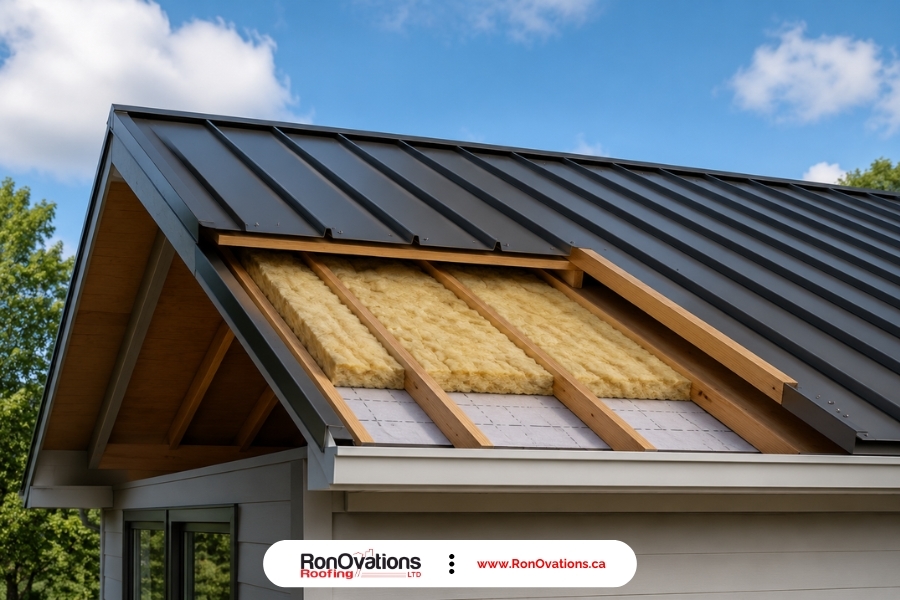
Metal roofing systems like Decra stone-coated steel sometimes include an air gap or rigid foam underlayment that adds R-3 to R-6, which is meaningfully more than asphalt’s R-0.44. Reflective metal surfaces can also reduce radiant heat gain in summer by 25% to 40%, which matters for cooling costs in July and August. Wondering how much a metal roof costs? The upfront investment is higher, but the thermal performance of the full assembly can offset that over time.
Does a metal roof insulate better than asphalt shingles?
The metal panel itself has almost no R-value, similar to asphalt. The difference is in the system. Metal roofing assemblies can incorporate rigid insulation boards or ventilated air gaps beneath the panels. Those additions bump the assembly’s thermal resistance well above what a standard asphalt shingle layup provides. But the real insulation still comes from your attic, not the roof covering. Don’t let anyone tell you a metal roof eliminates the need for attic insulation.
How much does a metal roof cost compared to shingles?
Metal roofing in Ontario runs roughly $9 to $15 per square foot installed versus $4.50 to $7.50 for architectural asphalt shingles (GAF Timberline HDZ, IKO Dynasty, CertainTeed Landmark). Metal roof maintenance is lighter than asphalt over the long haul, but you’ll still want annual inspection of fasteners, flashing, and sealant, especially after Ontario’s freeze-thaw cycles loosen things up.
Does a New Roof Save Energy? What to Realistically Expect
Let’s be honest: a shingle-only replacement on a home that already has decent insulation and ventilation might save 2% to 5% on heating and cooling. That’s real but modest. The big gains, 10% to 25%, come when you combine the reroof with insulation and ventilation upgrades. So does a new roof save energy? Yes, but the magnitude depends entirely on what you pair it with.
How much can a new roof reduce your heating bill?
The biggest variable is your starting point. A home with R-12 attic insulation upgraded to R-50 during a reroof will see dramatically different savings than a home already sitting at R-40. In Ontario, heating accounts for roughly 60% of home energy use. Even a 10% reduction in heat loss through the roof translates to meaningful dollar savings over a 25-year shingle lifespan. On a $3,000 annual heating bill, that’s $300 per year, or $7,500 over the life of the roof.
Does a New Roof Count as an Energy-Efficient Improvement?
A new roof with ENERGY STAR-rated shingles or cool-roof metal can qualify under certain federal and provincial programs. Be careful with promises here, though. Programs change year to year. The Canada Greener Homes Grant (now closed for new applications) and its successor programs have historically included insulation upgrades paired with a reroof among the most common claims.
Can you get rebates or tax credits for a new roof in Ontario?
The roof covering alone may not qualify. The insulation and air-sealing work done during a reroof often does. An EnerGuide home energy audit (before and after) is typically required to access rebates. Check the Natural Resources Canada website for current program details, as eligibility shifts with each budget cycle.
What a Reroof Plus Insulation Upgrade Costs in Ontario
For a typical 1,200 to 1,800 sq ft Ontario bungalow, the average cost of roof replacement runs $8,000 to $15,000 depending on the number of existing layers, decking condition, and shingle tier. BP Mystique sits at the value end; GAF Timberline HDZ and CertainTeed Landmark occupy the mid-range; IKO Dynasty and Owens Corning Duration push toward premium territory.
Blown-in insulation top-up to R-50 costs $1,500 to $3,500 for a standard attic. A ventilation upgrade with continuous ridge vent and new soffit vents runs $500 to $1,200. Total combined project: $10,000 to $19,000 for most Ontario homes. Two-storey homes with steep pitches trend toward the higher end. These are 2026 ranges and vary by region, material availability, and season. Spring and fall bookings tend to be tighter across the province.
Signs Your Current Roof Is Hurting Your Insulation
Look for specific, sensory indicators. Ice dams forming at the eaves every winter. Uneven snow melt patterns on the roof (hot spots mean heat is escaping). Drafts near ceiling light fixtures or attic hatches. Attic temperature swinging wildly compared to the rest of the house.
Granule loss in your gutters is a sign shingles are degraded and no longer shedding water properly, which leads to moisture intrusion that damages insulation below. Curling or lifting shingles allow wind-driven rain and snow into the attic space. A musty smell up there often means moisture has been sitting in the insulation for months. By that point, the insulation’s thermal performance is already compromised, and you’re paying for heat that’s going straight through the roof.
Roof, Insulation, and Ventilation Work as a System
A new roof does improve insulation performance, but it’s the combination of new shingles, modern underlayment, proper ventilation, and adequate attic insulation that delivers real energy savings. Each component supports the others. Skip one and the rest underperform. The best way to understand your specific home’s situation is to have the roof and attic assessed together, ideally before you commit to a scope of work.
Frequently Asked Questions
Does a new roof help with insulation?
A new roof improves insulation performance by replacing degraded underlayment, sealing air leaks around penetrations, and restoring proper ventilation. The shingles themselves add minimal R-value (about R-0.44 for asphalt), but the air-sealing and moisture protection they provide help your existing attic insulation work the way it should.
Does a new roof improve heating and cooling efficiency?
Yes, but the degree depends on your starting point. A reroof on a home with poor ventilation and degraded underlayment can noticeably reduce drafts and heat loss. Pairing the reroof with a blown-in insulation top-up to R-50 and a ventilation upgrade is where you’ll see the biggest impact on your heating and cooling bills.
Does a new roof count as an energy-efficient improvement?
It can, especially if you use ENERGY STAR-rated materials and combine the reroof with insulation and air-sealing work. In Canada, insulation upgrades done during a reroof have historically qualified for rebate programs like the Canada Greener Homes Grant. Check current federal and provincial programs, as eligibility changes year to year.
Should I add blown-in insulation when I replace my roof?
It’s the ideal time. Your contractor is already on site, the attic is accessible, and any air-sealing at the roof deck can be completed before insulation goes in. For most Ontario homes, topping up to R-50 costs $1,500 to $3,500 and delivers the single biggest energy improvement you can make during a reroof.
Does a metal roof insulate better than asphalt shingles?
Metal itself has almost no R-value, similar to asphalt. However, metal roofing systems sometimes include an air gap or rigid foam underlayment that adds R-3 to R-6. Reflective metal surfaces also reduce summer radiant heat gain by 25% to 40%, which helps with cooling costs. The real insulation still comes from your attic, not the roof covering.
How much does a reroof with insulation cost in Ontario?
For a typical bungalow, expect $10,000 to $19,000 for a combined asphalt reroof, blown-in insulation top-up to R-50, and ventilation upgrade. Two-storey homes with steep pitches or extensive decking repairs will trend higher. These are 2026 ranges and vary by region and season.