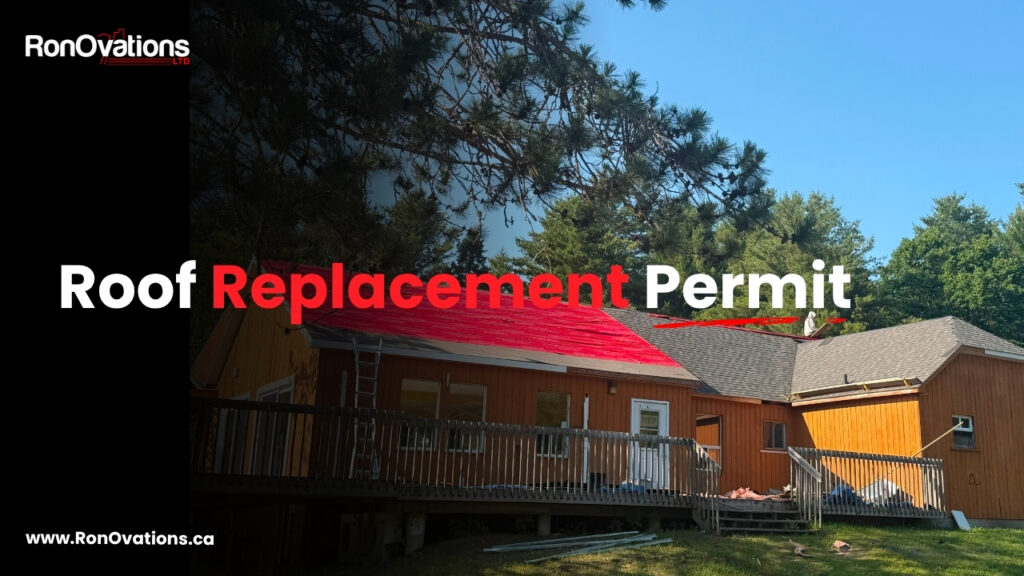
Quick answer: A straightforward like-for-like asphalt re-shingle often does not require a roof replacement permit in Ontario when the existing roof structure remains unchanged. A building permit may be required when the project includes structural alterations, changes to the roofline or slope, added dormers, certain skylights or solar installations, heavier roofing materials, or other work beyond basic re-roofing. The final decision belongs to your local municipal building department, so confirm the scope before tear-off begins.
Important: Ontario municipalities do not all describe roofing work in exactly the same way. A project that is permit-exempt in one city may need additional review in another, especially for heritage properties, commercial buildings, structural repairs, or material changes.
What This Ontario Roof Permit Guide Covers
- Do you need a permit to replace a roof in Ontario?
- Roofing work that is often permit-exempt
- When a roof permit may be required
- Toronto, Mississauga, Ottawa, and Barrie examples
- Permit process, cost, and timing
- Risks of working without a required permit
- Frequently asked questions
Do You Need a Permit to Replace a Roof in Ontario?
There is no reliable province-wide yes-or-no answer for every roofing project. Ontario’s Building Code Act establishes the legal framework for construction permits, but municipal building departments review applications and determine how a specific scope of work is handled locally.
For most homeowners, the key distinction is not simply whether the old shingles are removed. The more important question is whether the project remains a basic replacement of the existing roof covering or expands into structural, material, drainage, fire-safety, or building-envelope alterations.
A typical asphalt tear-off followed by new asphalt shingles on an unchanged, sound roof structure is commonly treated as re-roofing or maintenance. Toronto, Mississauga, Ottawa, and Barrie all publish examples showing that basic re-shingling or replacement of existing roofing material can be permit-exempt under stated conditions. Those conditions matter, and the exemptions should not be stretched to cover work that changes the structure or project scope.
Before booking a full shingle roof replacement, describe the project clearly to the local building department: the existing material, the new material, whether the decking will be replaced, whether the roofline is changing, and whether skylights, solar panels, dormers, or structural repairs are included.

Roofing Work That Often Does Not Need a Building Permit
Municipal rules vary, but the following types of work are commonly treated as routine maintenance or like-for-like replacement when no structural changes are involved:
- Replacing a limited number of missing, cracked, or wind-damaged shingles
- Repairing a small localized leak without altering the roof structure
- Re-sealing flashing, vent boots, or exposed fasteners
- Replacing asphalt shingles with new asphalt shingles on an unchanged roof
- Replacing existing roofing material where no structural work is required
- Re-shingling where the new roofing does not increase the roof load beyond what the municipality permits
- Replacing eavestroughs where drainage remains contained on the property and the roof structure is unchanged
“No building permit required” does not mean that workmanship, manufacturer instructions, safety requirements, property standards, or other applicable rules can be ignored. The roof still needs to be installed correctly, and separate approvals may apply to electrical work, heritage properties, conservation authority areas, solar equipment, or work affecting public property.
If the damage is localized, a professional roof repair assessment can help determine whether a targeted repair is practical or whether the roof has reached the point where replacement is the better long-term option. Homeowners comparing both options can also review our guide on whether to repair or replace a roof.
When a Roof Replacement Permit May Be Required in Ontario
A project is more likely to require a building permit or direct municipal review when it goes beyond replacing the existing roof covering. The following situations should be confirmed with the local building department before work proceeds.
1. Structural Roof Changes
Alterations to rafters, trusses, beams, load paths, roof framing, or structural supports are permit-sensitive work. Raising the roof, changing its slope, creating a new roof opening, or modifying the roofline is different from a standard re-shingle and normally requires plans and municipal approval.
2. Significant Sheathing or Roof-Deck Damage
Minor localized deck repairs may be handled differently from widespread replacement, but homeowners and contractors should not assume that extensive plywood, OSB, or structural deck work is covered by a basic re-shingling exemption. If tear-off reveals broad rot, sagging, fire damage, or compromised structural components, pause the work and contact the municipality before the area is covered.
This is one reason a roof estimate should explain how unexpected decking damage will be documented, priced, and approved. A low quote that assumes every sheet of roof decking is sound may not reflect the final scope once the old roofing is removed.
3. Changing Roofing Material or Increasing Roof Weight
Switching materials does not produce the same permit answer in every Ontario municipality. The important factors may include added weight, fastening requirements, structural capacity, fire performance, and whether the assembly itself is changing. For example, Barrie states that re-shingling is permit-exempt only when there is no increase in the weight of the roofing material.
If you are moving from asphalt shingles to a metal roofing system, stone-coated steel, tile, slate, or another materially different product, provide the municipality with the product type and installed weight rather than asking only whether “metal roofs need a permit.” A lightweight metal system installed without structural alteration may be reviewed differently from a heavy tile or slate assembly.
4. Skylights, Solar Panels, Dormers, and New Penetrations
New dormers, major skylight openings, solar equipment, rooftop mechanical equipment, and other additions can change structural loading or require new roof openings. Mississauga specifically lists roof extensions, slope changes, skylights, and solar panels among projects that require permits. Barrie also lists roof alterations such as dormers, skylights, and solar panels as permit-required work.
5. Flat Roof, Commercial, and Multi-Unit Building Work
A simple membrane replacement is not automatically permit-required everywhere, but flat and commercial roofing projects can involve insulation, drainage, fire-rated assemblies, rooftop equipment, parapets, structural deck repairs, and changes to the complete roof assembly. Confirm the scope before starting a flat roof replacement or repair, especially on commercial, industrial, mixed-use, or multi-unit properties.
6. Heritage Properties and Heritage Districts
A building permit exemption does not necessarily remove heritage approval requirements. Ottawa warns that designated heritage buildings and properties within a Heritage District Overlay are not covered by its standard permit exemptions. If a property is designated or located in a heritage conservation district, confirm both building and heritage requirements before changing roofing material, colour, profile, trim, or visible roof features.
Roof Replacement Permit Rules: Ontario City Examples
The table below summarizes the language currently published by several Ontario municipalities. These examples are useful for understanding the general pattern, but they are not a substitute for a project-specific answer from the municipality where the property is located.
| Municipality | Basic re-shingling or replacement | Examples that may require a permit | Official source |
|---|---|---|---|
| Toronto | Replacing existing roofing material is listed as permit-exempt when no structural work is required. | Structural alterations, roof-structure changes, or other work outside the exemption. | City of Toronto |
| Mississauga | Re-shingling a roof is listed under projects that do not need a permit. | Roof extensions, changes in height or slope, skylights, and solar panels. | City of Mississauga |
| Ottawa | Installing asphalt shingles on a roof is listed as permit-exempt. | Structural alterations and work on designated heritage properties or within applicable heritage overlays may require additional approval. | City of Ottawa |
| Barrie | Re-shingling is listed as permit-exempt when the roofing material does not increase in weight. | Roof alterations such as dormers, skylights, solar panels, and structural component repairs. | City of Barrie |
Other municipalities may use different terminology, publish less detail, or assess roof work case by case. When calling the building department, avoid asking only, “Do I need a roof permit?” Give them the actual project scope so the answer applies to your job.
What If Roof Damage Is Found After Tear-Off?
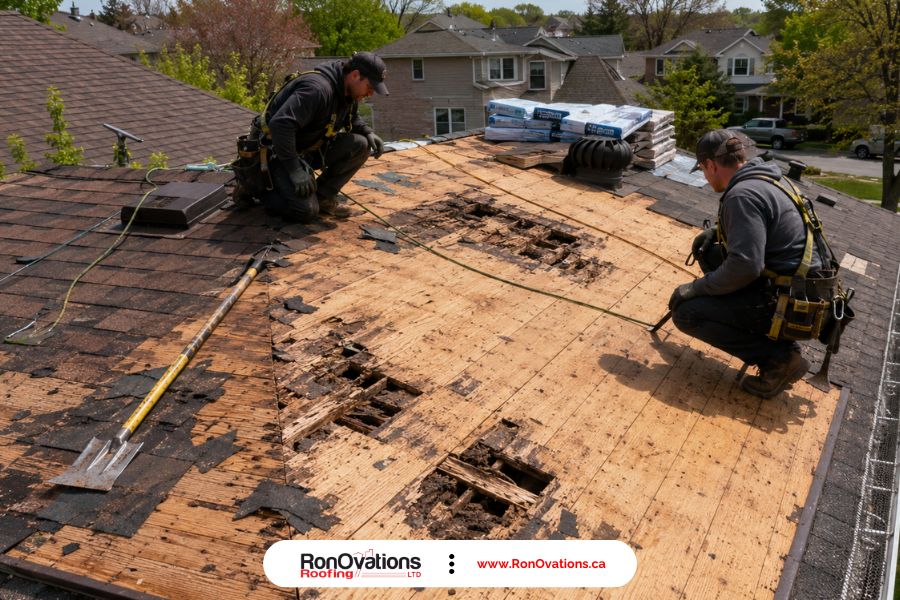
This is one of the most practical roof permit questions. A project may begin as a permit-exempt re-shingle, but hidden damage can change the scope after the old roofing is removed. Widespread rot, sagging decking, damaged rafters, failed trusses, or a need to rebuild part of the roof should not be treated as an automatic extension of the original work.
A responsible process is to:
- Stop work in the affected area and protect the exposed roof from weather.
- Photograph and document the damage before removing additional material.
- Separate minor deck replacement from structural framing repairs.
- Contact the local building department with the revised scope.
- Obtain any required permit, drawings, or inspection instructions before covering the work.
- Update the contract and price in writing before proceeding.
This approach protects both the homeowner and contractor. It also prevents critical work from being concealed before the municipality determines whether an inspection is required.
Roof Permit Process, Cost, and Timing in Ontario
How Do You Confirm Whether a Roof Permit Is Required?
Start with the municipality’s official building-permit page or contact its building department. Provide the property address and a concise scope that includes:
- Existing roofing material and number of roof layers
- Proposed roofing material and approximate installed weight
- Whether all old roofing will be removed
- Whether plywood, OSB, rafters, trusses, or other structural components will be repaired
- Whether the roof slope, height, drainage, or framing will change
- Whether skylights, dormers, solar panels, vents, or rooftop equipment will be added
- Whether the property is designated heritage, commercial, industrial, or multi-unit
Ask for the answer by email when possible, or note the staff member’s name, department, and date of the call. Permit rules and interpretations can change, so written confirmation is more useful than relying on a contractor’s general experience from another municipality.
How Much Does a Roof Permit Cost in Ontario?
There is no standard Ontario roof permit fee. Many basic re-shingling projects are permit-exempt, so the permit cost is zero. When a permit is required, the municipality may calculate fees using project area, construction value, permit category, minimum charges, or additional review requirements.
For example, Toronto’s current building permit fee schedule separates non-structural re-roofing from re-roofing with structural work and calculates those categories differently. Other municipalities use their own fee schedules. For an accurate roof permit cost, check the current municipal fee page after the building department confirms the permit category.
How Long Does a Roof Permit Take?
Approval time depends on the municipality, building type, project complexity, application completeness, and whether drawings or engineering are required. A straightforward structural repair application may be reviewed differently from a commercial flat-roof alteration or a roofline change.
Do not schedule tear-off based only on an estimated review date. If a permit is required, wait until it is issued and confirm the required inspection stages. Permit inspections occur at stages set by the municipality, and work should not be covered before an inspector has seen anything the permit requires to remain visible.
Should the Homeowner or Roofing Contractor Pull the Permit?
Either the owner or an authorized contractor may be able to submit the application, depending on the municipality and permit type. The contract should clearly state who is responsible for confirming the requirement, preparing documents, paying fees, booking inspections, responding to deficiencies, and closing the permit.
Regardless of who submits the application, the homeowner should receive the permit number, approved documents, inspection results, and final closure record. Do not accept “the permit is included” as the only documentation.
What Happens If You Replace a Roof Without a Required Permit?
The consequences depend on the municipality and the work completed, but starting permit-required construction without approval can create avoidable cost and delay. The City of Toronto warns that working without a required permit can lead to an additional administrative fee, stopped work while an application is processed, removal or exposure of completed work, added corrective work, and future legal or financial complications.
Toronto also notes that the homeowner can remain responsible for these consequences even when a contractor incorrectly said that no permit was needed. Review the City’s official working without a permit guidance for a clear example of the risks.
Potential problems can include:
- A stop-work direction while the permit issue is resolved
- Extra municipal fees or a retroactive permit process
- Having to uncover completed roofing so concealed work can be assessed
- Corrective construction if the work does not meet approved requirements
- Delays during a future sale, refinancing, or property-record review
- Insurance questions if a loss involves undocumented or non-compliant work
The safest approach is simple: determine the permit requirement before materials are ordered and before the roof is opened.
Questions to Ask a Roofing Contractor About Permits
A professional roofing proposal should make the permit responsibility easy to understand. Before signing, ask:
- Is this quote for a repair, re-shingle, full tear-off, or structural roof replacement?
- Which municipal rule supports the conclusion that a permit is or is not required?
- What happens if damaged sheathing or framing is discovered after tear-off?
- Who contacts the building department and who pays the permit fee?
- Are drawings or engineering included if the structure needs repair?
- Who books inspections and provides the final permit closure?
- Will all scope changes and extra costs be approved in writing?
Be cautious when a contractor gives the same permit answer for every city, dismisses the building department, refuses to identify the project scope in writing, or plans to cover structural work before municipal direction is obtained.
Roof Replacement Permit Ontario: Frequently Asked Questions
Do you need a permit to replace a roof in Ontario?
Not always. A like-for-like asphalt re-shingle with no structural work is permit-exempt in several Ontario municipalities, including Toronto, Mississauga, Ottawa, and Barrie under their published conditions. Structural changes, added roof features, heavier materials, or broader building-envelope alterations may require a permit. Confirm the exact scope with the local building department.
Does re-shingling require a permit in Ontario?
Basic re-shingling often does not require a permit when the roof structure is unchanged. Mississauga lists re-shingling as permit-exempt, Ottawa lists installing asphalt shingles as exempt, Toronto exempts replacement roofing where no structural work is required, and Barrie exempts re-shingling when the roofing weight does not increase.
Do you need a permit to replace roof sheathing in Ontario?
It depends on the amount of sheathing, the condition of the roof structure, and the municipality’s interpretation. Do not assume widespread decking replacement or structural repair is covered by a basic re-shingling exemption. If significant damage is uncovered, document it and contact the local building department before covering the work.
Does a metal roof need a permit in Ontario?
There is no universal answer based only on the word “metal.” The municipality may consider roof weight, structural changes, attachment method, fire performance, and the rest of the assembly. Confirm the specific metal product, installed weight, and project scope with the building department.
Do minor roof repairs need a building permit?
Small maintenance repairs such as replacing a few shingles, sealing flashing, or repairing a localized leak usually do not require a building permit when no structural alteration is involved. The answer can change if the repair expands into major decking, framing, roofline, or assembly work.
How much is a roof replacement permit in Ontario?
There is no province-wide price. Permit-exempt re-shingling has no permit fee. When approval is required, the cost depends on the municipality, project category, construction area or value, minimum fees, and whether structural review or additional documents are needed.
Can a roofer start before the permit is issued?
If the work requires a building permit, construction should not begin until the permit has been issued and the required inspection stages are understood. Ordering materials or protecting an emergency opening is different from proceeding with permit-required construction.
The Bottom Line on Roof Replacement Permits in Ontario
Many Ontario homeowners can complete a straightforward like-for-like asphalt re-shingle without a building permit. The answer changes when the work affects structural components, increases roof weight, changes the roofline or slope, adds new roof features, involves a heritage property, or alters a more complex flat, commercial, or multi-unit roof assembly.
Do not rely on a generic rule or a permit answer from a neighbouring city. Confirm the project scope with the municipality where the property is located, keep the answer with your project records, and make sure the roofing contract explains what happens if hidden damage changes the job.
Planning a roof project? RonOvations provides professional roof repair and roof replacement services across Ontario. Our team can inspect the existing roof, define the proposed scope, and help homeowners identify the permit questions that should be resolved before work begins.