The Hazards We Walk Into Every Morning
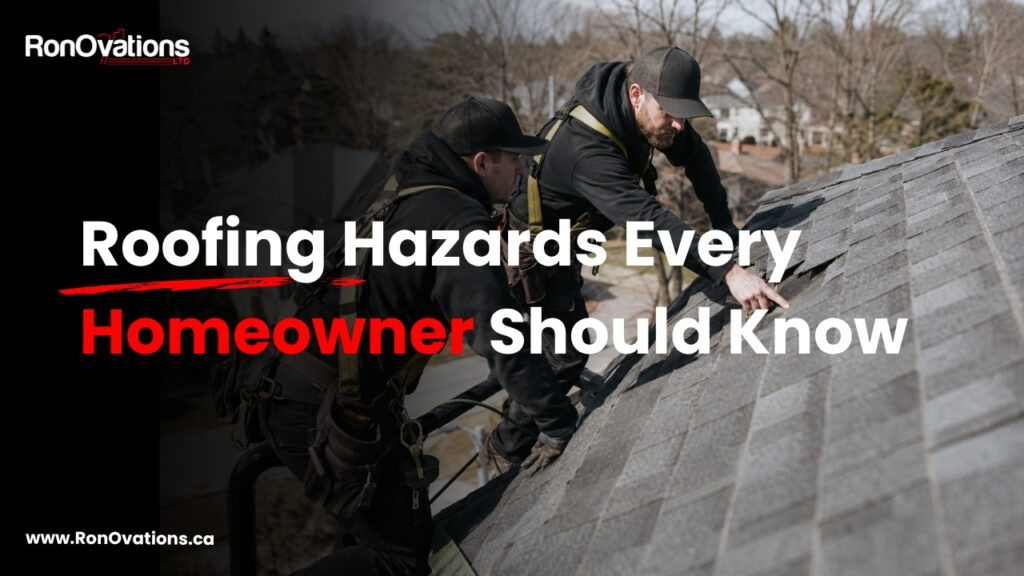
Roofing safety hazards start the moment you step off a ladder onto a sloped surface. Our crew at RonOvations has been GAF Certified, Owens Corning Preferred, and IKO ShieldPro Plus since we started in 2012, and we still treat every roof like it’s trying to hurt us. That isn’t paranoia. It’s pattern recognition built over hundreds of tear-offs across Ontario, Manitoba, and Alberta.Contractors must also select fall-protection equipment based on the height, roof design and provincial rules. See our complete guide to roof safety harness requirements in Canada.
WSIB data consistently ranks roofing among the highest-risk construction trades in the province. Falls account for the largest share of serious injuries, but they aren’t the only threat. Electrical lines, extreme heat, rotted decking, and even wasp nests hidden under fascia boards have all sent workers to the hospital. We’ve seen every one of these first-hand, and this article walks you through what we’ve learned so you can make smarter decisions about your own roof. premium siding services.
Need a Professional Roof Inspection?
If you’re concerned about loose shingles, roof damage, or safety risks around your home, RonOvations offers professional roof inspections across Ontario, Manitoba, and Alberta.
📞 Call us today or request a free quote.
Falls From Height, The Risk That Kills
What are the most common roofing injuries?
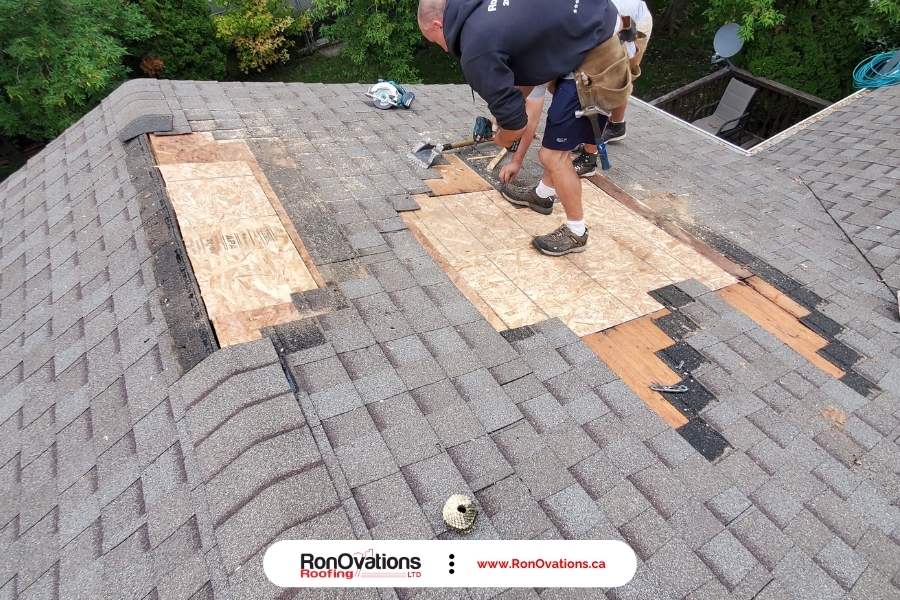
Falls are the leading cause of roofing fatalities in Canada, and it doesn’t take a three-storey Victorian to create a fatal scenario. A standard bungalow puts your eaves at 10 to 12 feet. That’s enough height to cause traumatic brain injuries, spinal fractures, and death. We’ve had a near-miss on a simple one-storey detached garage in Barrie where professional roof repair teams work daily, where morning dew turned aged BP Mystique shingles into a skating rink. The crew member’s harness caught him two feet before the eave edge.
Proper fall-arrest gear isn’t optional. CSA Z259-compliant full-body harnesses, shock-absorbing lanyards, and roof anchors rated for at least 5,000 lbs are the baseline. Ontario’s mandatory Working at Heights training, delivered through MOL-approved providers, must be refreshed every three years. If your contractor can’t show you a valid training card, that’s a red flag worth walking away from. roofing maintenance.
How do roofers stay safe on steep roofs?
Anything above a 7/12 pitch changes the game. Our crews install roof brackets (also called jacks) every 8 feet horizontally and lay planks across them to create stable work platforms. Toe boards along the lower edge catch tools and debris. Ladder tie-offs use stabilizers rated for the specific ladder length, and we anchor at the ridge, not the gutter. emergency roof repair services.
On pitches above 10/12, we bring in scaffolding or a boom lift. There’s no bravado in walking a 12/12 pitch freehand. We’ve watched YouTube videos of homeowners straddling a ridge cap with no harness, tossing shingles down to a driveway. That’s not DIY confidence. That’s a trauma call waiting to happen. our Vaughan Roofing Company roofing service.
Ontario’s Safety Rules Aren’t Optional
What safety gear is required for roofing in Ontario?
Ontario’s Construction Regulation (O. Reg. 213/91) requires fall protection at any height above 3 metres. The Ontario Building Code (OBC) governs the structural and material standards for the roof itself. Together, they create a framework that licensed contractors follow and that DIY homeowners often don’t even know exists. our Innisfil roofing service.
Here’s what the regulation demands at minimum: a CSA Z259.10 full-body harness, a CSA Z259.11 shock-absorbing lanyard, and a permanent or temporary roof anchor meeting CSA Z259.15. Hard hats, steel-toe boots, and eye protection round out the personal protective equipment. WSIB coverage is mandatory for contractors with employees, but a homeowner doing their own work has zero workplace insurance protection. If you fall off your own roof, OHIP covers the hospital visit, but lost income, rehab, and home modifications come out of your pocket.
We’ve seen homeowners try to anchor a harness to a plumbing vent stack. Those pipes are designed to vent sewer gas, not arrest a 200-pound fall. A proper temporary roof anchor bolts through the decking into a truss or rafter and gets sealed after removal. On one job in Newmarket, we found a previous homeowner had tied a rope around a bathroom exhaust fan housing and called it fall protection. That’s the kind of improvisation that ends careers and lives.
Can You Replace Your Own Roof? Here’s What We’d Tell a Friend
Is DIY roofing legal in Canada?
Yes, it’s legal for homeowners to reroof their own primary residence in most Ontario municipalities. Legal and safe aren’t the same thing. You’ll still need a building permit in most jurisdictions, and the finished work must pass an inspection against OBC standards. That means proper ice-and-water shield in valleys and at eaves, correct nail placement in the shingle’s nailing zone, and code-compliant flashing at every penetration.
Here’s the part that surprises most people: manufacturer warranties from GAF, Owens Corning, and IKO typically require installation by a certified contractor for full system warranty coverage. A GAF Timberline HDZ shingle installed by a homeowner might carry a limited material warranty, but you won’t get the 25-year workmanship coverage that comes with a GAF-certified install. That warranty gap can cost you far more than the $3,000 to $5,000 you’d save on labour.
We don’t say this to scare anyone out of a weekend project. We say it because we’ve torn off DIY roofs where the homeowner used roofing cement instead of step flashing, skipped the starter strip, and face-nailed every shingle. Those roofs leaked within two years. Understanding whether a roof can be repaired instead of replaced is often a smarter first step than jumping straight to a full DIY tear-off.
| Hazard Category | Risk to DIY Homeowner | How Professionals Mitigate It |
|---|---|---|
| Falls from height (above 3 m) | No harness, no anchor, no WSIB coverage | CSA Z259 harness, rated anchors, Working at Heights training |
| Electrical contact (service mast) | Ladder or metal flashing contacts live wire | Pre-job utility assessment, minimum 3 m clearance from lines |
| Heat illness (shingle surface 65-75 °C) | No acclimatization, no hydration protocol | Scheduled water breaks, early start times, buddy system |
| Structural collapse (rotted decking) | Steps through unseen soft spot | Decking inspection from attic before walking roof |
| Nail-gun injuries | Unfamiliar with recoil and safety mechanisms | Daily tool inspection, trigger-lock discipline, PPE |
| Warranty voidance | No certified-installer coverage from GAF, OC, or IKO | Manufacturer-certified installation with full system warranty |
Hidden Hazards Beyond the Fall
When is a roof too dangerous to walk on?
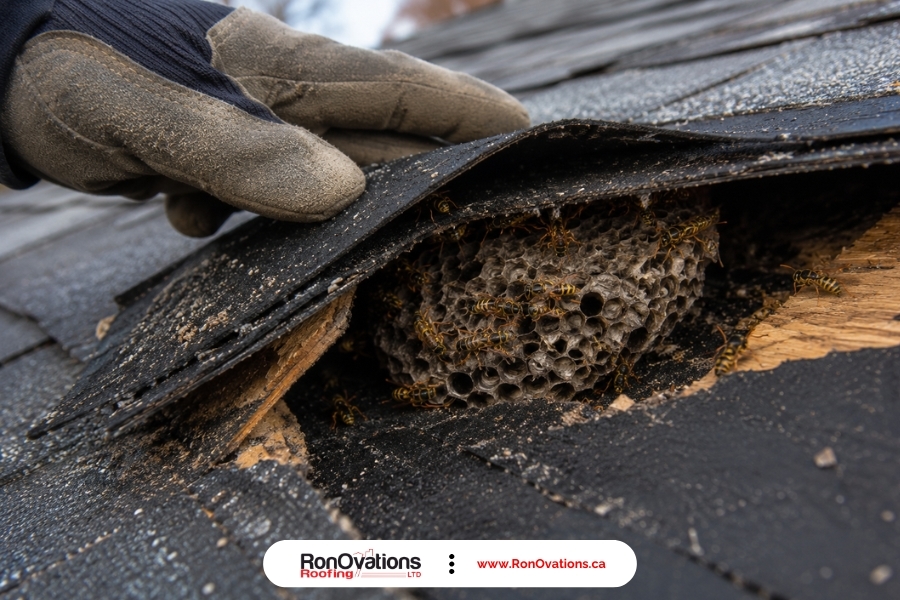
A roof is too dangerous to walk on when it’s ice-covered, wet from rain or morning dew, pitched above 10/12 without scaffolding, or showing visibly sagging or spongy decking. We also won’t walk a roof when the electrical service mast is within 3 metres of our work zone until the utility company installs a protective sleeve.
Overhead power lines are the silent killer on residential roofs. Aluminum ladders, metal flashing, and even wet lumber can conduct current. We’ve had a crew member’s ladder brush a service drop wire on a semi-detached in Hamilton. The breaker tripped before contact became lethal, but that’s not a safety plan. That’s luck.
Heat is another underestimated hazard. Dark asphalt shingles can reach 65 to 75 °C on a July afternoon. That’s hot enough to cause second-degree burns through work gloves and to trigger heat exhaustion within 30 minutes if you aren’t conditioned for it. Our crews start at 6:30 a.m. in summer and take mandatory water breaks every 45 minutes. A homeowner working alone on a Saturday doesn’t have a buddy watching for signs of heat stroke.
When Repair Makes Sense and When It Puts You at Risk
Can a roof be repaired instead of replaced safely by a homeowner?
Minor repairs like re-seating a few wind-lifted shingles are lower-risk, but they still involve climbing to height. If you’re comfortable on a stable ladder and the repair is within arm’s reach of the eave, a tube of roofing sealant and a handful of matching shingles can buy you time. That’s a fair DIY task.
The line gets dangerous when you need to walk the roof surface. If the roof is past 20 years, has multiple shingle layers, or shows widespread granule loss and soft spots in the decking, repair is a temporary fix that may mask deeper structural problems. We’ve pulled back a patch job on an Oshawa bungalow and found three layers of shingles over decking so rotten you could push a screwdriver through it. That homeowner thought they’d saved money. They ended up paying for a full deck replacement on top of the reroof. Roof replacement vs. repair is a decision best made with a professional inspection.
Metal Roofs, Ice Dams, and the Safety Angle Most People Miss
Do metal roofs prevent ice dams completely?
Metal roofs shed snow more efficiently than asphalt, which reduces ice dam formation, but they don’t eliminate it. If your attic insulation is thin and your ventilation ratio is off, warm air will still melt snow at the ridge, and that meltwater will refreeze at the eave. We’ve installed Decra stone-coated steel panels over poorly ventilated attics and had to come back to address ice damming the first winter. The roof wasn’t the problem. The attic was.
From a safety standpoint, metal panels are significantly more slippery than asphalt when wet or frost-covered. Crews working on standing-seam or corrugated metal use foam-soled roofing boots and cougar-paw style treads. A homeowner in running shoes doesn’t stand a chance. If you’re wondering how much is a metal roof, expect $9 to $14 per square foot installed in Ontario, compared to $4.50 to $7.50 for quality asphalt like IKO Cambridge or CertainTeed Landmark. The higher cost buys you a 40- to 60-year lifespan, but the installation demands professional-grade safety equipment and technique. Metal roofing options are worth exploring with a certified installer.
How a Proper Roof Install Affects Insulation and Efficiency
Does a new roof count as an energy efficient improvement?
A new roof by itself doesn’t add insulation value. But the tear-off process is the single best opportunity to upgrade what’s underneath. With the decking exposed or partially removed, adding blown-in cellulose or spray foam to the attic is far cheaper and more effective than doing it as a standalone project later. Homeowners searching for blown in attic insulation near me should consider timing the upgrade with a reroof for maximum savings.
The OBC requires a balanced ventilation ratio of 1:300 (one square foot of net free ventilation area per 300 square feet of insulated ceiling). Proper soffit-to-ridge airflow reduces summer cooling costs, prevents winter ice dams, and extends shingle life by keeping the deck temperature consistent. We’ve seen attics in 1970s-era Ontario homes with zero soffit intake, just a single gable vent doing nothing. Fixing that during a reroof adds maybe $400 to $800 to the project and pays for itself in energy savings within a few years.
Energy-efficient shingles like Owens Corning Duration with SureNail technology reflect more solar radiation than standard dark shingles, reducing attic heat gain. Whether your new roof qualifies for energy rebates depends on the specific program and your upgrade scope, but pairing a cool-roof-rated shingle with upgraded attic insulation often does qualify as an energy efficient improvement under programs like the Canada Greener Homes Grant. It’s worth checking before you sign a contract.
What a Safe, Code-Compliant Roof Project Looks Like
What should you expect from a professional roofing crew’s safety setup?
Before a single shingle comes off, a professional crew sets up perimeter warning signs, secures extension ladders with stabilizer arms, and installs temporary roof anchors at the ridge. Ground-level protection includes tarps to catch debris and a magnetic nail sweep at the end of every workday. If you’ve ever stepped on a roofing nail in your driveway, you know why that matters.
Every crew member wears a hard hat, full-body harness, and steel-toe boots. Eye protection goes on during tear-off and cutting. The foreman does a morning toolbox talk covering the day’s specific hazards, whether that’s proximity to power lines, forecast rain, or a known soft spot in the decking identified during the attic inspection.
Municipal inspectors typically visit after the underlayment and flashing are installed but before the finish shingles go on. They’re checking for ice-and-water shield placement, proper valley flashing, and ventilation compliance. A good crew welcomes that inspection because it confirms the work is right. A crew that tries to skip the permit process is telling you something about their standards. Roofing permits protect you as much as they protect the neighbourhood.
Protecting Yourself as a Homeowner Without Climbing Up
How can you verify a roofing contractor’s safety credentials?
You don’t need to climb a ladder to protect yourself. Before signing anything, ask for three documents: a current WSIB clearance certificate, proof of commercial general liability insurance (minimum $2 million is standard in Ontario), and a valid business licence for your municipality. Then verify manufacturer certifications directly on the GAF, Owens Corning, or IKO websites. Those databases are public and take 30 seconds to search.
Ask to see the crew’s Working at Heights training cards. A legitimate contractor won’t hesitate. Red flags include pressure to sign same-day, refusal to pull a building permit, and cash-only pricing with no written contract. BBB accreditation adds another layer of accountability, and you can check complaint history online before your first phone call.
Hiring an uninsured crew doesn’t just risk shoddy work. If an uninsured worker falls off your roof and gets injured, you could face personal liability. Ontario courts have held homeowners partially responsible in cases where they hired contractors without verifying insurance. That’s a risk no amount of savings justifies. Choosing a roofing contractor carefully is one of the best safety decisions you can make.
Frequently Asked Questions
Can I replace my roof myself in Ontario?
Yes, it’s legal for a homeowner to reroof their own primary residence in most Ontario municipalities. You’ll still need a building permit, and the finished work must meet Ontario Building Code standards. You won’t have WSIB coverage if you or a helper gets hurt, and manufacturer warranties from GAF, Owens Corning, and IKO typically require certified contractor installation for full system coverage. The safety risks and warranty gaps make professional installation the stronger choice for most homeowners.
Does a new roof help with insulation?
A new roof itself doesn’t add insulation, but the replacement process is the ideal time to upgrade attic insulation and fix ventilation problems. With the decking exposed, adding blown-in insulation or correcting blocked soffit vents is far cheaper and more effective than doing it later. Proper ventilation ratios (1:300 balanced intake and exhaust per the OBC) also reduce ice dam formation and extend shingle life by 15 to 20 percent.
What does the average cost of roof replacement look like in Ontario?
For a standard 1,200 to 1,800 square foot asphalt shingle roof in Ontario, expect $8,000 to $15,000 CAD depending on pitch, accessibility, decking condition, and shingle tier. Premium architectural shingles like GAF Timberline HDZ or IKO Dynasty sit at the higher end. Metal roofing runs $14,000 to $28,000 for the same footprint. These ranges include labour, materials, permits, and disposal but not structural repairs to decking or framing.
What safety gear is required for roofing work in Ontario?
Ontario’s Construction Regulation (O. Reg. 213/91) requires fall protection at any height above 3 metres. That means a CSA Z259-compliant full-body harness, shock-absorbing lanyard, and a roof anchor rated for at least 5,000 lbs. Workers must complete Working at Heights training through an MOL-approved provider and renew it every three years. Hard hats, steel-toe boots, and eye protection are standard PPE on any professional crew.
When is a roof too dangerous to walk on?
A roof is too dangerous to walk on when it’s ice-covered, wet with dew or rain, pitched above 10/12 without scaffolding, or showing visibly sagging or spongy decking. Active electrical hazards near the service mast also make a roof unsafe. Professional crews assess these conditions before every job and won’t proceed until the hazard is controlled or eliminated.
How often should metal roof maintenance be performed?
Inspect a metal roof twice a year, ideally in spring and fall. Check for loose fasteners, sealant degradation at penetrations, and debris buildup in valleys. Standing-seam panels need less fastener maintenance than exposed-fastener corrugated systems. After severe storms, a visual inspection from ground level with binoculars can catch dislodged panels or flashing damage before leaks develop. Professional maintenance every three to five years extends the roof’s 40- to 60-year lifespan.
Roofing safety hazards don’t disappear just because you’re the homeowner instead of the contractor. The physics of a fall, the voltage in a service line, and the heat radiating off dark shingles treat everyone the same. Whether you’re planning a full replacement or just trying to understand what your roofer should be doing up there, knowing these risks helps you make better decisions and ask sharper questions. For more on Ontario-specific roofing projects, visit our Ontario roofing services page.