Why “Just Go Light” Is Bad Advice for Canadian Roofs
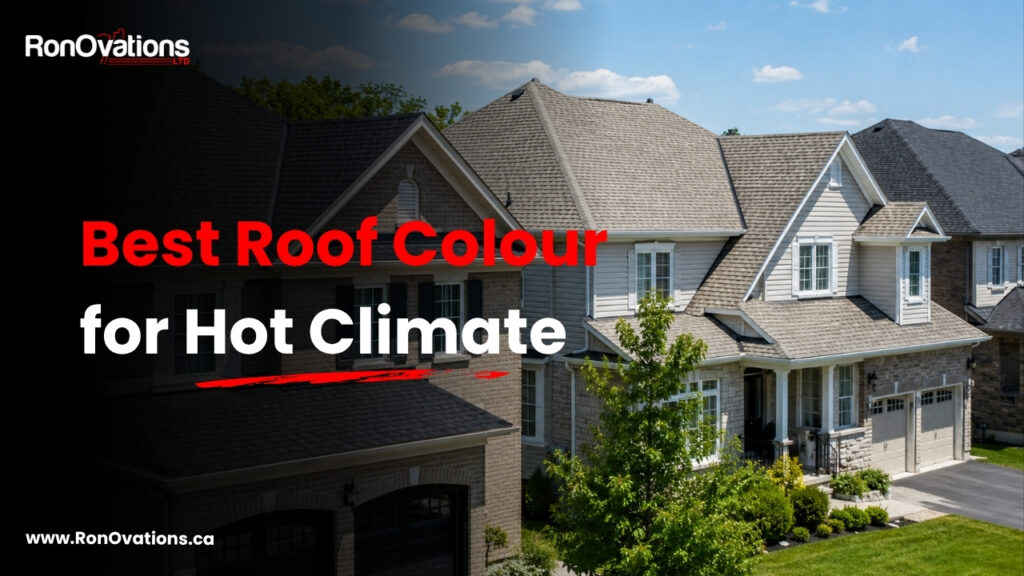
Choosing the best roof colour for a hot climate isn’t as simple as picking the lightest shade on the swatch card. That advice works in Phoenix or Miami, where cooling dominates the energy bill year-round. It doesn’t translate well to Ontario, Alberta, or Manitoba, where heating degree days outnumber cooling degree days roughly three to one. A roof that reflects summer sun also reflects winter sun, and that trade-off costs real money.
At RonOvations, we’ve been tearing off and replacing roofs since 2012. We’ve pulled infrared readings from attics under charcoal IKO Dynasty shingles and desert-tan Owens Corning Duration shingles on the same street, same day. The surface temperature gap is real. The indoor comfort gap? Much smaller than most online guides claim, especially once you factor in insulation quality and ventilation.
This article breaks down what roof colour actually does to your heating and cooling costs across all four Canadian seasons, which cool-roof products are available here, and why insulation upgrades during a re-roof deliver far bigger returns than colour selection alone.
Dark vs Light Shingles: What the Temperature Gap Actually Looks Like
Does a dark roof make your house hotter in summer?
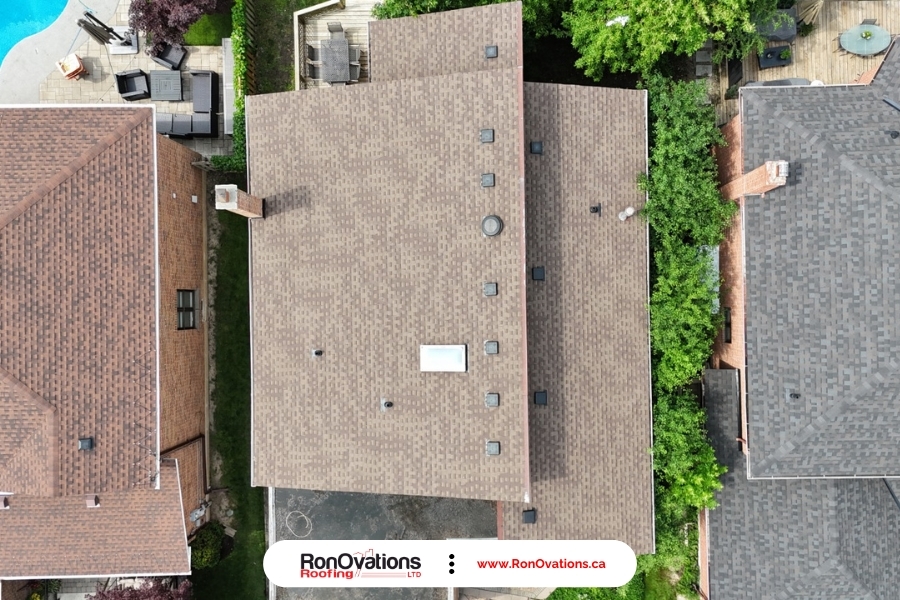
Yes, but the story has layers. On a 30°C July afternoon, a charcoal or black asphalt shingle can hit 75 to 85°C at the surface. A lighter shade like weathered wood or desert tan typically stays around 55 to 65°C. That’s a 20 to 30°C surface difference, and it’s measurable with a basic infrared thermometer.
Here’s the part most articles skip: that heat has to travel through your roof deck, your attic air space, and your insulation before it reaches your ceiling. With R-50 insulation and a properly vented attic, the temperature difference at the drywall is often just 1 to 3°C. We’ve confirmed this on dozens of tear-offs where we had the chance to measure before and after. The shingle colour matters, but it’s not the main event.
Homes with older R-12 to R-20 insulation and blocked soffit vents tell a different story. In those attics, dark shingles can push temperatures 8 to 15°C above ambient, and you’ll feel it downstairs. If that describes your house, upgrading insulation during a re-roof is a far better investment than switching from charcoal to beige.
How many degrees hotter does a dark shingle get compared to a light one?
Surface temperatures on dark shingles run 20 to 30°C higher than light ones under direct sun. The Solar Reflectance Index (SRI) quantifies this by combining solar reflectance and thermal emittance into a single number. A standard charcoal shingle might score SRI 15 to 20, while a light-grey cool-roof shingle can reach SRI 35 to 40. Higher SRI means less heat absorbed and less heat radiated into your attic.
The Winter Side Nobody Talks About: Dark Roofs and Heating Season
Does roof colour affect winter heating costs in Canada?
It does, and this is where the “just go light” crowd loses the plot. Dark roofs absorb more solar radiation during winter’s low-angle sun, slightly warming the attic space and reducing the temperature differential your furnace has to overcome. In a province like Ontario, where heating season runs roughly October through April, that passive solar contribution adds up.
Consider the math. If a light roof saves you $80 to $120 per cooling season but adds $40 to $60 in extra heating costs, your net annual savings shrink to $20 to $60. That’s real, but it won’t pay for a colour change on its own. And during months when snow covers the roof, colour is completely irrelevant because the snow reflects sunlight regardless of what’s underneath.
Older homes with thinner insulation feel the winter penalty more. We’ve seen cases in rural Ontario where homeowners who switched from dark to light shingles noticed their January gas bills creep up. It wasn’t dramatic, but it was measurable, and nobody had warned them.
How Much Can Roof Colour Really Save on Cooling Costs?
Can a lighter roof colour lower my air conditioning bill?
In Canada, a cool-roof shingle can reduce cooling energy use by 10 to 20 percent. But Canada’s cooling season is short, typically June through August in most of Ontario. If your summer AC costs run $400 to $600, you’re looking at $40 to $120 in savings per season. That’s meaningful over a 25-year roof lifespan, but it won’t transform your energy bill.
Savings depend heavily on three factors: your home’s total square footage, whether HVAC ductwork runs through the attic (common in two-storey homes), and your current insulation level. Ductwork in a hot attic is the biggest energy thief we see. A light roof helps, but insulating and sealing those ducts helps more.
ENERGY STAR cool-roof standards require an initial solar reflectance of 0.25 or higher. Several shingle lines available in Canada meet this threshold, and we’ll cover them below.
Solar Reflectance Index: The Number That Matters More Than Colour
What is the Solar Reflectance Index and does it matter for shingles?
SRI is a 0-to-100-plus scale that tells you how much heat a roofing surface accumulates under standard conditions. It combines two properties: solar reflectance (how much sunlight bounces off) and thermal emittance (how quickly absorbed heat radiates away). A matte black surface scores 0. A bright white membrane scores around 100.
Most standard asphalt shingles land between SRI 15 and 35. Cool-roof shingles with infrared-reflective granules push into the 25 to 40-plus range. Metal roofing with factory-applied coatings can hit SRI 25 to 50 or higher, depending on colour and finish.
Here’s the practical takeaway: SRI matters more than visible colour. A medium-brown cool-roof shingle with IR-reflective granules can outperform a standard light-grey shingle that lacks those granules. So you don’t have to sacrifice curb appeal for energy performance.
| Roof Material / Colour | Typical SRI Range | Summer Surface Temp (°C) on a 30°C Day | Best Suited For |
|---|---|---|---|
| Standard dark asphalt shingle (charcoal/black) | 10 – 20 | 75 – 85 | Heating-dominant zones, well-insulated homes |
| Standard light asphalt shingle (tan/grey) | 25 – 35 | 55 – 65 | Balanced climates, moderate insulation |
| Cool-roof asphalt shingle (IR-reflective granules) | 25 – 40+ | 50 – 60 | Year-round balance, any insulation level |
| Light-coloured metal roofing | 40 – 55+ | 40 – 55 | Long-term energy savings, hot-summer regions |
| Stone-coated steel (Decra) | 30 – 50 | 45 – 60 | Durability plus reflectance, all climates |
Cool-Roof Shingle Brands Available in Canada Right Now
Which shingle brands offer cool-colour technology in Canada?
Several manufacturers sell ENERGY STAR-rated cool-roof shingles through Canadian distributors. Here’s what we install and what we’ve seen perform well:
- Owens Corning Duration COOL: Available in multiple colours with IR-reflective granules. Meets ENERGY STAR initial reflectance requirements. We’ve installed these across the GTA and they hold colour well after five-plus years.
- CertainTeed Landmark Solaris: One of the first cool-roof shingle lines in Canada. Offers a limited lifetime warranty and solid SRI numbers in lighter colour blends.
- IKO Cambridge Cool Colours: Enhanced solar reflectance in select colour options. IKO manufactures in Canada, so supply is consistent.
- GAF Timberline HDZ Cool Series: Cool-series options exist, though Canadian availability varies by region and distributor. Worth asking your contractor to source if you want GAF’s wind warranty.
- Decra Stone-Coated Steel: Not a shingle, but worth mentioning. Factory-applied coatings deliver high reflectance with a 40-to-70-year lifespan. We install Decra for homeowners who want metal performance with a traditional profile.
If your contractor can’t tell you the SRI rating of the shingle they’re quoting, that’s a red flag. Any GAF Certified or Owens Corning Preferred Contractor should have this data on hand.
Why Roof Colour Is Only Half the Equation
Does a new roof help with insulation?
A new roof doesn’t add insulation by itself, but a re-roof is the best time to fix what’s underneath. When our crews strip the old shingles, we can see the deck condition, check for moisture damage, and identify insulation gaps that have been hidden for decades. We routinely find older Ontario homes with R-12 to R-20 attic insulation and compressed batts that have lost half their rated value.
Upgrading to R-50 or R-60 blown-in cellulose or fibreglass during a re-roof is far more cost-effective than doing it as a standalone project. The attic is already exposed, and the crew is already on site. This single upgrade will outperform any colour change by a wide margin. The average cost of roof replacement in Ontario ranges from $7,000 to $15,000 CAD for asphalt shingles on a standard 1,200 to 1,800 square foot home, and bundling insulation work into that project saves on labour.
How does attic ventilation affect roof temperature?
Balanced intake and exhaust ventilation keeps attic air closer to outdoor ambient temperature, which reduces the impact of shingle colour on indoor comfort. The National Building Code of Canada (NBC) requires a minimum 1:300 ventilation ratio (one square foot of net free vent area per 300 square feet of attic floor). Many older homes don’t meet this standard because soffit vents are blocked by insulation or ridge vents were never installed.
We’ve measured attic temperatures drop by 10 to 15°C simply by adding proper soffit baffles and a continuous ridge vent during a re-roof. That dwarfs the 1 to 3°C ceiling difference between dark and light shingles in a well-insulated home.
Picking a Roof Colour for Energy Efficiency Without Ignoring Winter
Should I prioritize roof colour for energy savings or curb appeal?
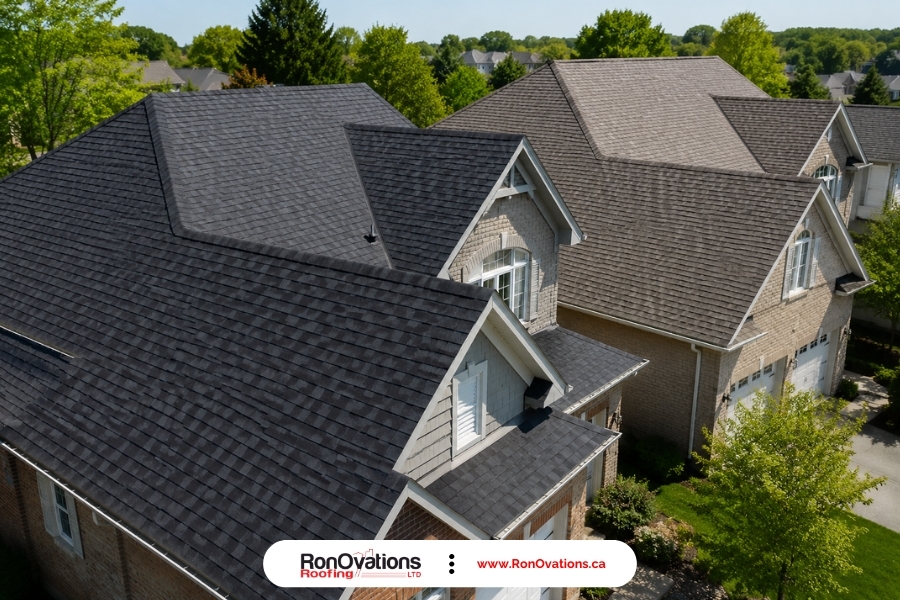
If your home already has R-50 insulation and balanced ventilation, pick the colour you love. The energy difference between a dark and light shingle in a well-insulated Canadian home is modest enough that curb appeal should win. A roof colour that complements your siding, stone, and trim can add real resale value, and that’s worth more than $60 a year in energy savings.
If your insulation is thin or your attic ventilation is poor, a lighter or cool-roof shingle gives you a measurable summer comfort boost while you plan insulation upgrades. In heating-dominant zones like Northern Ontario or the Prairies, a medium-tone shingle with cool-roof granules is the sweet spot. You get IR reflectance without sacrificing winter solar absorption.
One honest opinion from our crew: we’ve never had a homeowner call back to complain about their roof colour’s energy performance. We have had plenty call about ice dams, attic condensation, and high heating bills, all of which trace back to insulation and ventilation, not colour.
Metal Roofing and Colour: A Different Calculation
Does metal roofing stay cooler than asphalt shingles?
Metal roofs release absorbed heat faster than asphalt because metal has higher thermal emittance. A dark metal roof cools down significantly within an hour of sunset, while dark asphalt shingles can radiate stored heat well into the evening. This means metal roofs contribute less to overnight cooling loads, which is a real advantage during heat waves.
A light-coloured standing-seam metal roof can achieve SRI values above 50, outperforming even the best cool-roof asphalt shingles. The trade-off is cost: the cost of a metal roof runs $10 to $18 per square foot installed in Ontario, compared to $4.50 to $7.50 for asphalt. That puts the total metal roof installation cost for a typical 1,500 square foot home between $15,000 and $27,000 CAD. But metal lasts 40 to 60 years versus 20 to 30 for asphalt, so the per-year cost often works out lower.
We install Decra stone-coated steel for homeowners who want metal durability with a shingle-like appearance. It’s a strong option when you want high reflectance, long lifespan, and neighbourhood-friendly aesthetics. Consistent metal roof maintenance, including annual inspections and clearing debris from valleys, helps these systems reach their full 50-plus-year potential.
Common Myths About Roof Colour and Energy
Will a white roof eliminate my need for air conditioning?
No. A white or very light roof reduces cooling load by 10 to 20 percent, not 100 percent. Solar heat through windows, internal heat gains from appliances and occupants, and humidity all drive AC demand independently of roof colour. In Canada’s short cooling season, a white roof is a modest helper, not a replacement for a properly sized air conditioner.
Does roof colour void my shingle warranty?
No. Manufacturer warranties from GAF, Owens Corning, IKO, and CertainTeed are based on product line, installation standards, and ventilation requirements, not colour. Choosing a darker or lighter shade within the same product line doesn’t change your warranty coverage. What can void a warranty is improper installation or inadequate ventilation, so make sure your contractor is certified by the manufacturer.
Frequently Asked Questions
Does roof colour really affect your energy bill?
Yes, but the effect is smaller in Canada than most online guides suggest. A lighter roof can reduce summer cooling costs by roughly 10 to 20 percent, translating to $40 to $120 per cooling season for a typical Ontario home. That same light roof absorbs less solar heat in winter, slightly increasing heating demand. The net annual impact depends on your insulation level, ventilation quality, and the ratio of your heating to cooling spending.
Is a light-coloured roof always better in Canada’s climate?
Not automatically. Canada’s heating season is roughly three times longer than its cooling season in most provinces. A light roof helps in summer but offers no passive solar warming in winter. If your attic insulation is R-50 or above and ventilation is balanced, the colour difference is modest either way. A medium-tone cool-roof shingle with IR-reflective granules often strikes the best year-round balance for Canadian homes.
What’s the best roofing material for energy efficiency?
Light-coloured metal roofing with factory-applied reflective coatings delivers the highest SRI values (40 to 55+) and the longest lifespan (40 to 60 years). For homeowners who prefer the look of traditional shingles, cool-roof asphalt products like Owens Corning Duration COOL or CertainTeed Landmark Solaris offer a good balance of reflectance, cost, and aesthetics. The best roofing material for your home also depends on slope, budget, and local building code requirements under the Ontario Building Code (OBC).
Do dark roofs cause ice dams in winter?
Roof colour isn’t the primary cause of ice dams. Ice dams form when heat escaping from the living space melts snow on the roof deck, and the meltwater refreezes at the cold eaves. A dark roof might accelerate surface snowmelt on sunny winter days, but the root cause is almost always inadequate attic insulation and air sealing. Fixing those issues prevents ice dams regardless of shingle colour.
How long do cool-roof shingles last compared to standard shingles?
Cool-roof shingles use the same base materials as standard architectural shingles. Products like Owens Corning Duration COOL and IKO Cambridge carry the same warranty terms as their non-cool counterparts, typically 30 to 50 years limited lifetime. The IR-reflective granules don’t reduce durability. In fact, by keeping shingle surface temperatures lower, cool-roof granules may slightly slow thermal aging over the roof’s lifespan.
Roof colour is one factor in your home’s energy performance, but it’s far from the most important one. Insulation quality, attic ventilation, and ductwork location all have a bigger impact on your heating and cooling costs than whether you choose charcoal or desert tan. If you’re planning a re-roof, treat it as a chance to address all four factors at once. For more on roofing options across the province, see our Ontario roofing resource page. Homeowners in Huntsville looking for professional roofing services or those in Parry Sound seeking reliable contractors can explore local options. If you’re considering roofing materials specifically designed for warm climates, our detailed guide covers performance data and cost comparisons. For those interested in different types of roofing materials available in Canada, we break down the pros and cons of each option. Proper metal roof maintenance practices can extend the lifespan of reflective metal roofing systems significantly. Residents in Midland needing roof replacement or repair can find certified RonOvations contractors nearby. Those in Gravenhurst planning a re-roof project should consider insulation upgrades at the same time. For homeowners in Severn exploring energy-efficient roofing options, cool-roof shingles offer measurable summer savings. If you’re in Oro Medonte and need a roofing assessment, our team can evaluate your attic insulation and ventilation during the inspection. Residents of Creemore looking for local roofing expertise can schedule a free consultation to discuss colour and material choices.